
How Can We Innovate Through External Growth?
As I discussed in my previous article , “External Growth to Expand Your Business,” considering the acquisition of a company is a genuine way to innovate—a unique strategy for tapping into the hidden market as a reservoir of potential innovations. How should you go about it?
SUCCESSFUL EXTERNAL GROWTH: THE 3 KEY STEPS
The primary goal of an acquisition is to combine the resources of two entities in order to build a joint venture that is stronger than the sum of its parts.
To succeed in this endeavor, it is necessary to look beyond the financial aspects of the transaction and engage in a comprehensive, systematic process characterized by three key stages: identifying targets, evaluating them, and finalizing the deal:
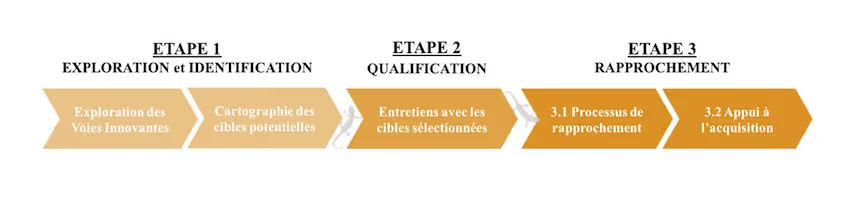
IDENTIFYING THE RIGHT COMPANIES TO ACQUIRE
The process begins with a phase that defines the scope of the research, in line with the strategy, while retaining the flexibility to adapt the strategy to the specific context of the identified targets. It is important that this starting point be reasonably broad, as the success of the process depends on the qualitative “funnel effect” of the screening process. This stage helps identify potential growth avenues (diversification, vertical integration, etc.). It is therefore absolutely essential to approach the subject with a deep understanding of the relevant fields (technical, industrial, sector-specific, environmental, human resources, etc.) in order to transform innovation opportunities into growth targets.
“The success of the approach (…) depends on the qualitative funnel effect of the alignment process … to transform innovation opportunities into growth targets.”
The core of the approach lies in fostering dialogue and constructive exchange of business strategies:
Some of the prerequisites include not limiting yourself to “NAF” codes and not contacting only companies “for sale” or those whose executives appear to be nearing retirement. Why?Because it is always possible to uncover synergies for a merger when you approach the process with empathy and a deep understanding of the companies involved.
Furthermore, “timing it right” is becoming less and less rare in an economy where cycles are shortening and executives are constantly attuned to market demands.
The goal is to make initial contact—methodically and tactfully—to get past the first line of contact and begin exploring the selected companies (about twenty), meet with their executives, present the project, and quickly establish a positive environment for discussion: discussing the potential of the partnership, mutual benefits, highlighting positive synergies, and sharing a common vision, because at this stage, the goal is not (yet) to acquire the company, but ratherto assess the alignment of values and corporate profiles.
“Timing the market is becoming less and less rare in an economy where cycles are getting shorter and executives are constantly attuned to market signals.”
IDENTIFYING MERGER AND ACQUISITION OPPORTUNITIES
Whether or not it confirms the viability of the merger, the second stage also aims to minimize “post-acquisition” surprises. It is also at this point that strategies can align to make the most of the proposed partnership.
If the companies do merge in the future, each must see its own interests served; this is a courtship process during which the trust essential for moving forward must be established. It is common at this stage not to discuss money—and thus valuation.
By applying this framework to all target companies met, trends, aspirations, and projections will emerge, and as a related benefit of this approach, an updated map of the ecosystem’s players will be created. Each exchange helps to formalize a vision of the target company, its potential, and its alignment with the development plan.
Among all these companies, some will appear far more relevant than initially anticipated, or conversely, less interesting. Some were not for sale but will reconsider because the process leads them to envision a new horizon—perhaps more solid, more promising. Engaging with this hidden market allows these opportunities to emerge.
“Some weren’t for sale, but they’re going to give it some thought because the process is leading them to consider a new path—perhaps one that’s more stable and more promising.”
HOW TO COMPLETE A BUSINESS BUYOUT
And then… three or four projects will be selected to foster closer relationships and more formal information exchanges with a view to developing a potential partnership—this is the third stage. It will allow leaders to get to know one another, share their visions, and exchange their values.
At this stage, if there is a good rapport—which reinforces the previous steps—the parties can begin to develop a joint project that will gradually incorporate the necessary financial valuation and the synthesis of the validated synergies (otherwise, the discussions will quickly come to an end without any consequences).
The final milestone in the process—setting out the terms of the merger in a letter of intent—marks the start of the audit phase (tax, financial, legal, and social) or “due diligence” phase, which leads to the conclusion of the process (“closing”).
Warning! Selling a business is not a common occurrence; the process is a complex mix of financial metrics, social factors, industrial sustainability, psychology, and personal emotions. The entire situation remains in a delicate balance until the very last moment. And until that final moment, it is therefore essential to stay focused on the project and remain attentive.
Ultimately, innovation through external growth rests on two fundamentals: a focus on people and a deep understanding of the business lines involved; it explores the potential of “hidden” markets in a broad and systematic way, without limiting itself to mere financial transactions. And it relies on a structured approach, progressing through successive, qualifying, and iterative stages, following the principles of a traditional innovation process.
Related articles

Frédéric Chazelle

Entrepreneurship is a renewable and universal source of value that empowers the men and women who embrace it. Wherever it flourishes, new ways of seeing the world emerge, new forms of wealth take shape, and new opportunities arise. It instills confidence in the future within its ecosystem and plays a leading role in driving a country’s growth (in the broadest sense). Contributing to its emergence and development has always inspired and guided my career. Having founded and led a company before supporting startups and high-growth businesses, I now dedicate myself to business matchmaking.