
Innovation Funding: Maximize Your Chances of Success
Innovation funding policies are overwhelmingly designed to encourage you to innovate. These public policies address a wide range of issues: reducing the financial risk associated with an innovation project, providing leverage to help you secure additional funding (from your banks or investors), “sponsor” your projects (reduce costs), and more. The purpose of this article is to highlight the opportunities available to you and reassure you about the best practices that exist so you can approach these processes with confidence. Because, in fact, the landscape of financial aid—whether local, national, or European—is vast, and it is highly likely that you can benefit from one or more forms of financial support throughout your innovation process: technical and economic feasibility, R&D, development, pre-industrialization, commercialization, and export.
“GREAT! SO I HAVE LOTS OF OPTIONS!”
Of course! And on top of that, there is a wide variety of mechanisms, of different origins and types:
- Grants: Bpifrance, H2020, regional governments, etc.
- Loans and repayable advances: Bpifrance, regional governments…
- Tax exemptions: CIR, CII, JEI.
Developing an innovation funding strategy to secure the right support at the right time
What constitutes good financial assistance? Can I apply for more than one type? How do I choose between them (grant, loan, repayable advance, etc.)? What are my chances of success?
The Right Helper
At first glance, one might think that a grant is an excellent option for meeting the needs of an innovative company. However, grants often involve fierce competition among applicants and thus have a low success rate. In contrast, since the funding pools for repayable advances or innovation loans are larger, the chances of success are much higher.
In practical terms, the right assistance will depend on your actual needs:
- Reduce the risk of failure and encourage entrepreneurs to launch their projects:
–>Grants are designed to support risky yet promising projects, particularly those that are disruptive.
–>Tax exemptions also help reduce the financial burden of the project on the company. However, you will only benefit from these exemptions after the expenses have been incurred.
- Accelerate development: If you need to invest quickly and significantly in your project to accelerate development, then Recoverable Loans or Advances can be accessed more quickly (since you can apply on an ongoing basis) and thus provide you with the funds you need to invest promptly (hiring, purchasing equipment, outsourcing, etc.). In France, these programs typically include a grace period that allows you to begin repaying the loan or advance once your innovation starts generating profits.
At the right time
An innovation project is a long journey marked by obstacles to overcome. Each obstacle or decision point can be represented by a key milestone:
- Market research
- Technological feasibility
- Developments
- Pre-industrialization
- Market launch
- Etc…
Most funding agencies offer programs to support these expenses. For example, you can find grants to validate technological feasibility, followed by a repayable advance to support development.
The SME Instrument (Phase 2) or the Innovation Competition could be excellent tools to help you prepare for the commercialization of your innovation.
Besoin de trouver des financements pour votre projet ? Souad, experte en financement de l’innovation, vous explique la méthode Dynergie.
Leading and Managing Your Innovation Project: Mapping Innovation Funding
ANTICIPATE – MANAGE – ACT
PLAN AHEAD: It is important to time things carefully. Most funding must be applied for before incurring expenses. Putting together a funding application is a process that can take time. Until the application is submitted, the expenses incurred are not eligible.
In addition, some funding programs have application deadlines that should be identified in advance to properly prepare your application and maximize your chances of success.
MANAGING: Align your roadmap with the identified funding opportunities. To create a relevant funding roadmap, you need to have a thorough understanding of French and European programs and what each one funds. To that end, my first piece of advice is to seek guidance from experts who continuously monitor these programs, have practical experience with them, and are fully familiar with the eligibility criteria and the structure of the applications to be submitted.
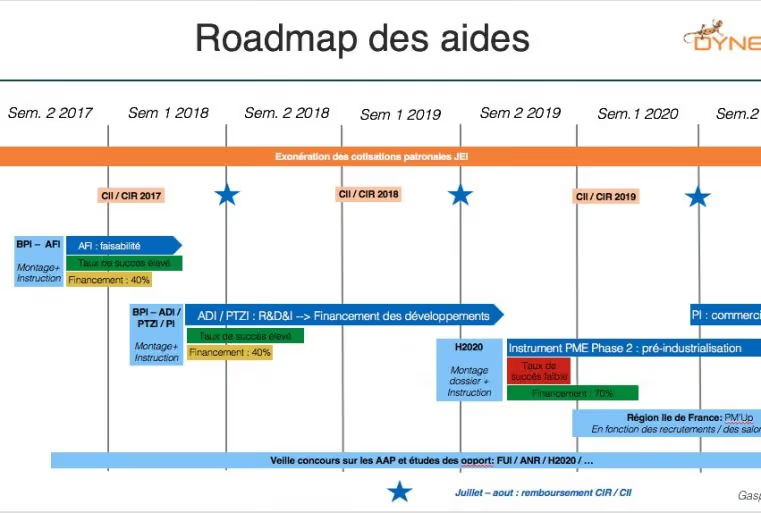
The funding assistance roadmap above will help you understand the various programs, your chances of success, the amounts you can obtain, and the deadlines for applying for each grant. This will give you the key metrics you need to easily steer your funding strategy.
TAKE ACTION: Once your roadmap is ready and you have identified calls for proposals, competitions, or other funding opportunities, you need to put together your funding application. At this stage, your project’s business plan must be very clear, because in addition to the innovative nature of your product and its technological maturity, funders will want to understand your strategy for turning your innovation into a true success story:
- In the market: What is your target market? How have you validated it? Do you have pre-orders or intent-to-order commitments? What will your revenue model be? Do you have distributors? Do you sell directly? etc.
- Regarding your teams' skills: profiles of team members and their ability to drive development.
- Regarding the financial sustainability of your business: demonstrate that you have a financing plan capable of supporting the costs of an innovation.
- Etc…
Il est indispensable d’avoir un discours clair et précis pour rencontrer ces financeurs et les convaincre de votre projet. Les experts de Dynergie ont toutes les compétences pour vous aider à bâtir et structurer votre business plan, pour rédiger l’intégralité du dossier et des parties demandées, etc.
A well-executed innovation funding strategy will help you improve the performance of your innovation.
In fact, securing additional financial resources will help ensure the success of your project (for example, by funding preliminary studies to strengthen the project’s foundation); optimize your ROI (by reducing costs); optimize your cash flow; and improve the quality of development (by hiring experts).
Related articles

Gaspard Wibaux

Passionné par l’innovation et les nouvelles technologies, j’ai rejoint les équipes de Dynergie en 2010 pour accompagner les entreprises innovantes à structurer leurs projets et à obtenir les financements répondant à leurs besoins (CIR / CII, FUI, BPI, H2020, export, etc.) Mon bagage scientifique et mes expériences antérieures me permettent d’intervenir dans un vaste champ d’applications incluant mécatronique, robotique, science de l’information, etc.