
360° Innovation: A Key Factor in the Success of Your Projects
In our previous articles, you’ve had the opportunity to learn about our vision of innovation. I’d now like to explain what makes the success of an innovation project so complex and what our strategies are for ensuring that a new service or product generates significant business. Finally, I’ll go on to explain how our services are structured to ensure the greatest possible success for innovation projects.
WHY TAKE A 360-DEGREE APPROACH TO INNOVATION?
If you’re used to reading articles about innovation on blogs, in white papers, or on LinkedIn, you’re probably aware that 95% of innovative projects never see the light of day or aren’t profitable enough.
In the previous article, Gabriel Genieis, our Director of Innovation, explained that, in our view, innovation MUST drive business; that is the conviction we have developed. Innovation must be based on a pain point, a problem, and solve that problem through a strong value proposition.
The technical solution is not the value proposition; thinking this way is a common cause of failure. It is the alignment of several components that ultimately makes it a success, hence the concept of 360-degree innovation: this is what I will explain in the paragraph below.
THE COMPONENTS OF SUCCESSFUL INNOVATION
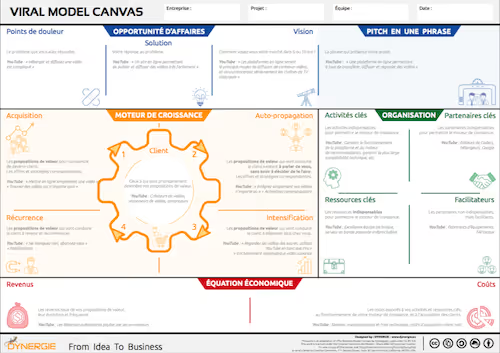
I have grouped them into three categories, which together form a combination: TECH – DESIGN THINKING – BUSINESS PLAN
- A suitable technical solution: an innovation must be technologically up-to-date, ideally based on proven technologies (at the very least, that’s less risky). The risk of opting for a disruptive technology (whose feasibility has not been demonstrated) does not necessarily guarantee success… which brings me to the next point.
- Innovation must address specific needs: “purists” call this “design thinking.” For example, one of Decathlon’s greatest strengths is its ability to create sports equipment tailored to the specific practices and needs of a sport. Every product is tested by users (before it goes on sale!) to validate all its uses and confirm that all pain points have been addressed. You’ve no doubt got plenty of innovative products in mind that Decathlon has successfully launched… most recently, the mask that’s revolutionizing snorkeling: their innovation engineers solved the problems of visibility, fogging, breathing, and water seepage in the snorkel and mask… in short, all the pain points that could make snorkeling less than enjoyable.
- La validation du modèle économique : il faut absolument tester le modèle de revenu et le prix de vente maximum que l’on peut tirer… dès le début de la phase de concept. J’ai en mémoire le développement d’un petit équipement industriel innovant sur lequel DYNERGIE avait travaillé. Le concept, la technologie, les usages étaient optimaux et nos équipes spécialistes des financements de l’innovation avaient mobilisé des aides publiques (subvention et crédit d’impôts) permettant une prise en charge de 90% du projet. A l’issue de la phase de prototypage, notre client avait organisé une journée « portes ouvertes » regroupant de grands donneurs d’ordre qui s’étaient enthousiasmés pour le produit, et l’avaient testé; les intentions de commande étaient là, mais tout était retombé comme un château de cartes au moment de l’annonce du prix de vente. Conclusion : le produit ne s’est jamais vendu. Depuis, avant le moindre développement, nous vérifions systématiquement que nous pouvons le vendre.
Enfin, il faut être bien conscient qu’un projet d’innovation coûte cher. Depuis que Dynergie existe et après avoir accompagné des centaines de projets d’innovation, nous constatons qu’un projet revient à minima à un investissement de 300K€ (de sa preuve de concept à la commercialisation), quelque soit le sujet. C’est un minimum car un projet industriel coûtera nettement plus cher. Combien de nos clients pensaient investir quelques dizaines de milliers d’euros pour arriver à une solution prête à être commercialisée, et ont décidé d’arrêter en cours de route, à cause des moyens importants qu’il leur fallait investir.
Laissez-moi vous expliquer dans ce dernier paragraphe comment DYNERGIE peut vous accompagner sur la réussite d’un projet d’innovation.
I want a free diagnosis!
LA RÉPONSE DE DYNERGIE AVEC SON OFFRE À 360° AUTOUR DE L’INNOVATION
Dynergie a pour seul objectif que les projets d’innovation qui passent entre ses mains soient une réussite. En plus de 10 ans d’existence, c’est avec des échecs et beaucoup de réussites que nous avons façonné une offre globale permettant d’intervenir à n’importe quelle étape d’un sujet d’innovation, de la génération de concepts innovants à sa commercialisation.
In this context, our offering is structured around two key areas:
Support for leveraging public funding mechanisms to support innovation and R&D
La société DYNERGIE est née de la compétence conjointe de ses fondateurs, Xavier LEVESY, ancien chargé d’affaires de l’ANVAR (aujourd’hui Bpifrance) et possédant plus de 20 ans d’expérience en financement d’entreprises innovantes, et de Louis VEYRET, entrepreneur et spécialiste du financement de haut de bilan et de l’accompagnement d’entreprises innovantes. Leur objectif a été d’offrir à toutes sociétés la capacité à mobiliser tous les dispositifs d’aides publiques visant à soutenir des projets d’innovation, qu’ils soient menés de façon individuelle (avec éventuellement des prestataires) ou de manière collaborative sur le sol français et européen. Les aides que nous mobilisons prennent la forme d’un crédit d’impôt (montant qui va se déduire de l’Impôt sur les Sociétés ou qui va être remboursé en cas de résultat négatif ou à l’équilibre), d’une subvention (argent non restitué à l’organisme financeur) ou un prêt à taux zéro (somme remboursée à l’organisme financeur, avec 3 ans de différé de remboursement). Notre ingénierie financière globale permet une prise en charge des projets pouvant aller jusqu’à 100% (en moyenne, 70% de prise en charge en cumulant 2 aides). Nous disposons dans ce domaine de références clients allant de la startup aux grands groupes.

Operational support for growth strategies through innovation
We aim to secure financial investment in a project to ensure not only its profitability but also the company’s genuine growth through innovations in products, services, and business models.
The key is to find the best solution to address an identified problem. Our innovation champions will study and analyze everything that could jeopardize the project’s viability—including economic, regulatory, technical, and cultural risks (negative publicity)—in a highly methodical and systematic manner, addressing these issues one by one.
As explained in the first paragraph, we always start with the pain points of our clients—and especially our clients’ clients—identifying what the problem is and where we can take action. Once all these steps have been completed (more details in our article “How to Make Your Innovation Project a Success Like No Other!”), we’ll discuss the project and, through physical and digital testing, we’ll technically implement the proposed solution.
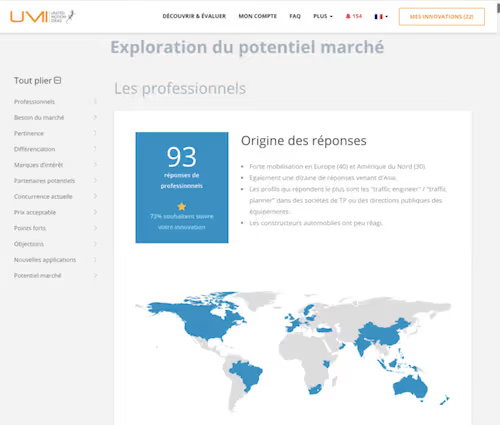
We can also use our proprietary UMI web platform to validate a concept’s potential by gathering at least 30 qualified expert reviews in less than three weeks. Among our innovation champions, our teams include former startup founders who have the expertise to develop concepts and validate their business potential using agile methods—a approach that appeals to large corporations whose processes may be rigid.
Finally, if—as part of our growth strategy recommendations—the most effective way to implement innovation is through external growth, then we have an expert who can screen potential targets, contact them, evaluate them, and then, based on a shortlist, initiate discussions leading to the acquisition of one or more companies.
I hope this article inspires you to reach out to us to see how we can help you make your project a success.
Please feel free to contact us to schedule an initial meeting.
Related articles

Stève Laffitte

My motto: to serve my clients by connecting them with my top experts. With our support, I aim to ensure their businesses achieve the greatest possible success through innovation. That’s what drives me—and my team—every day.