
Launching an Innovation Project: The Innovation Pyramid
As we discussed, in the first part of this five-part series on the innovation pyramid, the insight that led us to develop our approach to structuring innovation projects. In this second installment, I’ll explain the philosophy behind this innovation pyramid approach.
The innovation pyramid is, first and foremost, a philosophy
This pyramid is a simple yet highly effective symbolic representation of the innovation process. It illustrates the key stages involved in structuring and ensuring the success of an innovation project and has proven its worth time and again with our clients. It captures the core principles of our approach, powerfully and visually distilling the very essence of an unstoppable strategy.
Building a Stable Foundation for Our Project
Launching a new business is like being an explorer sailing the high seas. You’re sailing toward uncharted territories, but the journey is far from easy. Sometimes the sea rages, storms rumble, and strong winds are not uncommon. It’s best to have a sturdy, stable vessel. Whether on land or when it comes to your project, what could be more stable than a pyramid? The achievements of the Egyptians, at any rate, prove me right. The Pyramid of Innovation is our plan for laying a solid foundation for an innovation project, to secure its potential before moving forward with its execution and the often substantial expenses associated with it.

The Path to His Goal
It consists of three successive levels leading up to the pinnacle: the development of the project itself. Each of these levels represents a fundamental building block of the project that must be secured before embarking on its development. They must be addressed in a very specific order that leads to the construction of the future project. Just as we start by laying the foundation before building the roof of a house, we follow the same logic here. First, the problem; then, the solution; and finally, the associated business model. First comes the “Problems” stage—which we refer to here as“Pain Points”—and which involves grounding our project in the existence of a significant frustration among our target audience. This frustration, if successfully resolved, will ensure strong interest from the affected segment. Next comes the solution, which is designed toaddress the identifiedpain point and must be tested with users to verify that it effectively addresses the chosen pain point. Finally, the business model —which is how we’ll generate revenue with our solution by delivering value to our target market. Here again, we’ll need to assess the market’s appetite for our value proposition and the associated business model.

The truth isn't in your office
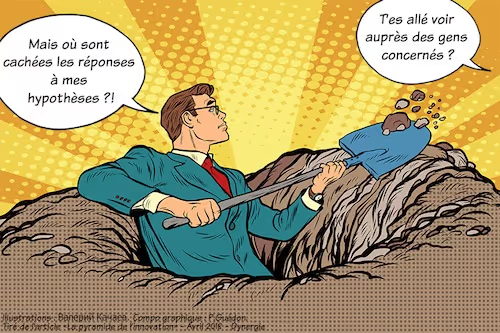
Admitting that we don’t know something in an innovation project is a big step toward success, since it forces us to question our often-false assumptions and seek the truth where it can be found: among users and consumers. Each stage of the pyramid is designed to be outward-facing—whether to gather, validate, or challenge the ideas and hypotheses we’ll develop throughout the process. Let’s start with the definitionthat innovation means providing a solution to a pressing problem —a solution that will resonate in its market and thus create business potential. So, whether we’re talking about the problem, its solution, or how to make money from that solution, in every case, the answers lie in engaging with the user and then the customer.
The market is the arbiter.
To complete the development process—and, above all, before making a significant investment in the actual development of the envisioned product or service—you must sell your concept to the market. This market test is the ultimate arbiter; it provides the final validation of the concept.
Related articles

Sophie Joliet
