
Launching an innovation project: the current situation
In the following paragraphs, I would like to share with you our approach to innovation, both in its symbolic and structured forms. Drawing on a few examples of failures in the implementation of innovation projects, I will illustrate the philosophy behind our solution and then detail the key steps in the process leading to success.
The Findings
People often come to us with the same challenges, the same pain points. They’ve had a great new business idea that was supposed to be a real growth driver for their company. They launched the project at great expense because they thought they had THE right idea—a deep intuition, a conviction drawn from their experience in the industry. Unfortunately, the results quickly turn out to be less than encouraging, and the difficulties in bringing the product to market and achieving profitability soon become apparent. The diagnosis is often quite simple: Is there actually a customer need? Is there a solution that addresses a genuine customer pain point? Is the value proposition valid? And isthere market appetite for the proposed business model? All these points (and many others) represent project risks that must be mitigated when venturing into the murky world of innovation, where certainties are nothing more than smoke and mirrors. Sometimes, luck is on our side and our intuition proves correct. However , the probability of getting it right based solely on intuition is low. Ignoring the need to address these factors is like rolling the dice on the potential success of your innovation. Yet innovation is expensive. It’s best to minimize the role of chance as much as possible in an endeavor that already carries enough risk without adding to it.
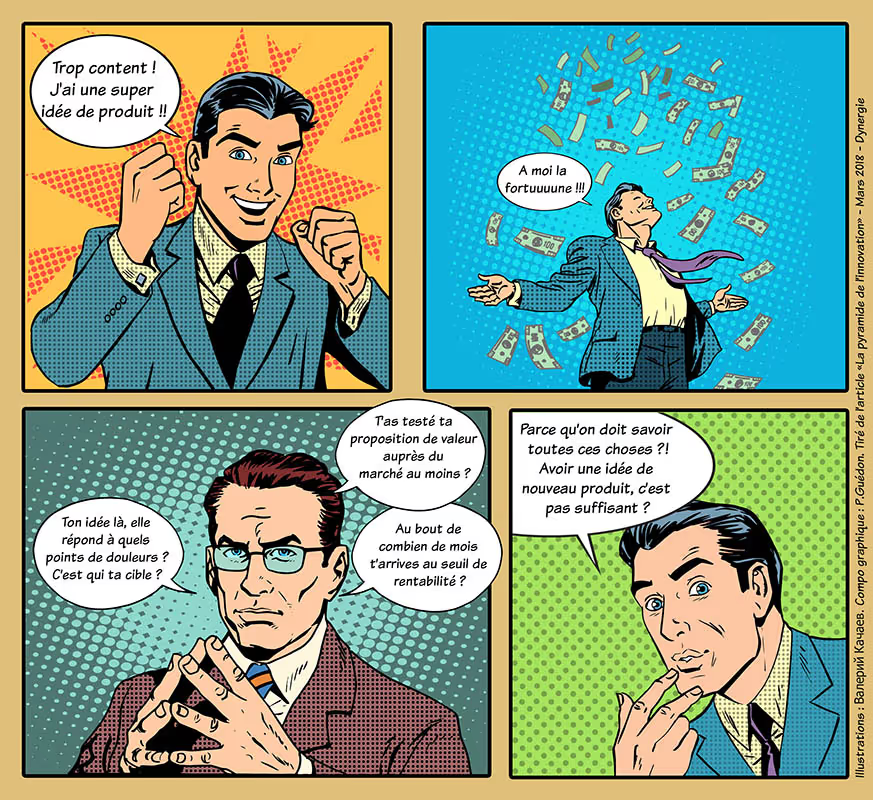
On a different note, but still arriving at the same conclusion, we also see these product improvement projects that stem from a simple observation: my product is selling less and less. Sales are slowing down, and the arrival of competitors is gradually dragging me into a price war that—if I don’t take action—will sooner or later spell the end of what I rely on for my livelihood today. The common reflex in this kind of situation is the unfortunate tendency to believe that, to break out of this downward spiral, the product must be redesigned by adding a whole host of new features in order to create a competitive edge and improve the price-to-feature ratio. However, as in the previous case, sales of this new version do not fare any better than those of the previous product, and this is for one simple and good reason: people don’t buy features. They buy the answer to their frustrations, the solution to their pain points. If the features added to the product resolve some of their frustrations, then there will be interest. It is solely from this perspective that innovation must be created.
It was in light of this observation—quickly illustrated by the two previous cases—that we developed our approach to innovation projects, with the aim of helping our clients navigate these high-stakes issues. The goal is very clear: to determine how to ensure the success of an innovation project, validate its potential, and give it the best possible chance of succeeding by reaching its target market and achieving profitability.
The goal: To successfully develop a new, profitable business through innovation.
Related articles

Sophie Joliet
