
Strategy for Acquiring and Leveraging Innovations
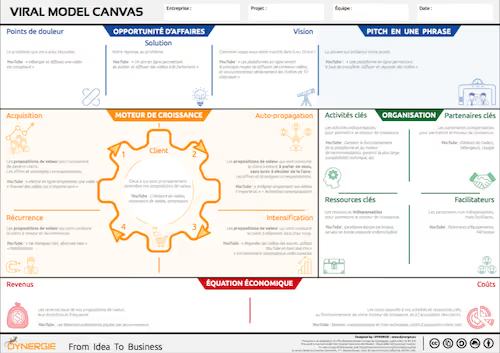
The article “How to Make Your Innovation Project a Success Like No Other!” by Sébastien Deschaux explains how to systematically verify the fundamentals and assumptions to ensure your project gets off to a strong start. The key to customer acquisition , therefore, lies in how you structure your innovation project. Through our tool, the Viral Model Canvas, you’ll discover how to secure your innovation project, convince investors, acquire new customers, and thus turn your projects into successes.
Business Model Canvas: The Drawbacks…
- Why a new framework?
The Business Model Canvas, a widely recognized standard, was developed by Alexander Osterwalder in 2010. While it is excellent for explaining what you want to do, it does not address the need that drives the project or the growth strategy required to achieve that outcome. The Viral Model Canvas was created to address these two gaps.
- The Business Model Canvas omits the Business Opportunity
The raison d’être of any innovation project lies in the opportunity you’ve identified—a gap in the market or a problem that can now be solved. This could be Uber’s idea of ordering taxis via a geolocation app, or Apple’s idea of replacing bulky Walkmans with iPods… In short, an opportunity to offer a better, cheaper, more user-friendly service or product, etc. The value of your project boils down to this difference between what already exists and what is possible: this is the Business Opportunity. However, the Business Model Canvas does not present the purpose of your project, which makes it difficult to use when presenting your idea to investors.
- The Business Model Canvas omits the growth driver
The Business Model Canvas is a snapshot. It shows how a business operates at a specific point in time. In the case of a startup, it depicts how the company will operate in the future, but not how to get there. As Eric Ries would say, growth is a startup’s core business. For this simple reason, the Business Model Canvas—which is well-suited for established companies—does not meet the strategic planning or communication needs of startups.
Win Over Investors with the Viral Model Canvas
- Summary of the Business Opportunity and Elevator Pitch
By definition, an elevator pitch is a very difficult exercise designed tocapture an investor’s attention in less than 30 seconds. It is minimalist perfection. It must focus on the business opportunity. By highlighting the difference between the initial situation without your innovation and the situation with your innovation, you demonstrate the value of your project. By presenting your vision for the industry in five years, you highlight your project’s potential. With the Viral Model Canvas, you can build a compelling elevator pitch in just three boxes. Have you captured investors’ attention with your elevator pitch? Now you need to convince them of your growth strategy to turn that potential into reality.
Developing an Effective Customer Acquisition Strategy
The Viral Model Canvas forces you to think about your value propositions from the perspective of extreme growth.
- What is a growth driver?
The growth engine describes how a company acquires, develops, and retains its customers. In the Viral Model Canvas, the growth engine consists of four parts, corresponding to four different value propositions:
▪︎ Acquisition: Your value proposition to convince prospects to become customers:
○ It must be targeted, meaning it should focus only on the segment of prospects for whom your solution is essential. Forget about lukewarm prospects—they require too much effort to convince.
○ It must be easy to adopt, risk-free, and effortless. If the initial investment is significant, you’ll slow down adoption. If your innovation is complicated, include training and initial support. If your innovation requires an initial financial investment, offer subscription plans and provide the equipment—as mobile operators have done, for example. In short, make adoption easy.
▪︎ Self-propagation: your value proposition—often distinct from the previous one—that encourages customers to talk about you without having to make a conscious decision to do so. This approach helps create a viral coefficient greater than 1.
Here are a few examples:
○ Uber lets you share your trip’s live location with the person waiting for you, so you don’t have to text them every five minutes.
○ Mail-in-black, the anti-spam system, requires email senders to prove they’re human, which means everyone who writes to a Mail-in-black customer hears about it.
○ Airbnb offers to increase the visibility of a listing by sharing it on other social media platforms. To maximize their financial gain, the advertiser thus becomes an Airbnb promoter.
So the question you need to ask yourself is this: What can you offer your customers that will benefit them and get them talking about you? How can you structure your operations, distribution, and features to achieve this result?
▪︎ Up-selling: What additional value-added offers can you provide to a user who is already a customer? Facebook, for example, lets you post classified ads and earn money through your network.
▪︎ Recurrence: How can you organize your service to maximize its reuse? This can take the form of a flawless service strategy (like luxury hotels), creating high switching costs (banks/insurance companies), or implementing high-value-added offers that extend customer commitment (renewing a cell phone contract at a good price in exchange for a new 24-month commitment).
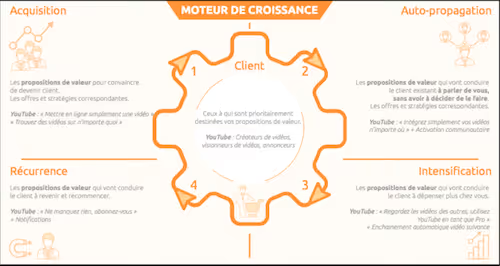
By structuring your value propositions, operations, organization, and strategy around these four approaches, you’ll build a solid and profitable growth engine. Your first customers will come naturally; they’ll tell others about your service or product; you’ll increase your margins by better leveraging your existing customers; and you’ll lose very few customers.
To clarify your business opportunity, convince investors, create a growth engine, and turn your innovation into a business, we invite you to try the Viral Model Canvas. Give it a try, and feel free to contact us if you need any help.
Related articles

Dynergie Expert

Our collective is committed to making innovation a driver of change. Our experts share their expertise with you so that, together, we can pave the way toward a brighter future.