
How to Make Your Innovative Startup a Success by Stanley Robotics
Renowned for its fundraising efforts, innovative technology, television coverage, and press coverage, Stanley Robotics is one of the most successful innovative French startups. Launched in January 2015, the company develops a robotic valet parking solution primarily deployed at airports. By parking cars more densely, the robot reduces the space occupied by vehicles, allowing more cars to be accommodated in the same parking lots. The startup thus contributes to increased traffic flow within the airport while minimizing environmental impact. Travelers benefit too: less time searching for an open spot, less stress about missing your flight, less walking to reach your car, and your car is safe from inconsiderate drivers. Stéphane Evanno, COO of Stanley Robotics, takes the time to share his secrets to success! The concepts discussed may seem obvious, yet they are often poorly implemented by innovative startups.
Find at least one paying customer right from the start!
The Stanley Robotics Approach
Working with airports wasn’t part of the original plan. The idea came about after seeing someone use a car mover—a device that grips a car’s two wheels and allows the car to be moved by pulling the car mover manually. For Stanley Robotics, robotics was meant to automate this process.
After coming up with this idea, the founders sought out the client with the most pain points. Drawing on their startup experience, they hypothesized that their idea was worthless and that the real value lay in the problem itself. They therefore set out to find a client for whom the pain point was significant enough to validate their idea and justify continuing the project’s development.
Their goal wasto identify the market where their solution would quicklydeliver the most value.
It’s not always easy to identify the right market. An advantage for an innovative startup: airports are relatively unfamiliar with robotics and artificial intelligence technologies. Furthermore, Stanley Robotics wasn’t looking for a partner to help them develop their technology from a technical standpoint, but rather a complementary partner with a different culture. The challenges faced by airports presented an opportunity for them: traffic increases by 10% every year. At an airport attracting 10 million visitors annually, that represents 1 million additional passengers each year. Just over a third of these future visitors will park in the parking lots. The airports’ pain point is clear: how to accommodate new visitors in a space where there is no more room and where vertical expansion is very costly.
Before beginning to design a technical solution and build prototypes, Stanley Robotics took the time to understand the market. This is a crucial step, and Stéphane advises startups to talk to as many customers as possible.
Using a concept video—which Aurélien and Clément (his partners) call “the tape-and-string video”—they filmed a car mover moving on its own. In reality, the controls were taped down and the machine was being pulled. However, this allowed potential customers to visualize the concept. This video led to many meetings with project managers: parking lot operators, car rental companies, automakers…
Working with a large corporation as a startup
Stéphane's tips for effective cooperation
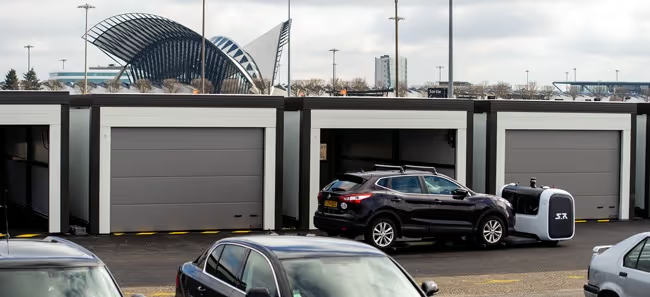
Dans le cas de Stanley Robotics, la construction de leur robot s’est faite techniquement chez eux. Mais pour être exploitable, il était indispensable qu’il soit co-construit avec les équipes des aéroports. Selon Stéphane, la difficulté se trouve dans l’équilibre pour faire travailler ensemble une startup qui a ses propres contraintes, temporalités et ambitions et un grand groupe qui est régi par d’autres forces. Le pilotage du projet par Dynergie, cabinet de conseil en innovation, et la coordination des acteurs ont été des éléments clés dans la réussite du projet.
Between large corporations and startups, working together effectively isn’t always easy. Large companies have a wealth of expertise, but sometimes they need help articulating it due to the fragmentation of stakeholders (the silo effect is more pronounced). The question a startup must ask itself is:“Do I fully understand the structure of the large corporation I’m going to work with?” You need to know the key players, their roles, their contributions, etc., and ask them questions before getting too far into the project. Otherwise, the project can very quickly be derailed by the dynamics among the players.
The pitfall for large corporations is that they “push” innovation but don’t delve deeply enough into the process, unlike startups, which understand that innovation must address a real problem and a real market, and requires quickly bringing a product to market that aligns with those needs.
Starting a startup is a personal journey
Building a cohesive team
Stéphane, COO of Stanley Robotics, has spent a lot of time in the startup world. His goal: to drive innovation that directly translates into “business innovation.” It is this vision that he wanted to apply to his startup. Building a successful startup requires a lot of sacrifice.
The entire team at Stanley Robotics is deeply committed to the project; everyone knows why they’re there and what they need to do. It’s a human adventure. As he puts it himself: “I feel like I’ve gotten 10 years younger.”

It’s fun every day, with strategic decisions to make as a team on a daily basis, and no one on the team is sitting around twiddling their thumbs
Stanley Robotics now has more than 50 employees. The startup is constantly evolving, and new employees are hired on a regular basis.
According to Stéphane, a strong founding team with complementary skills is essential for a startup’s success.
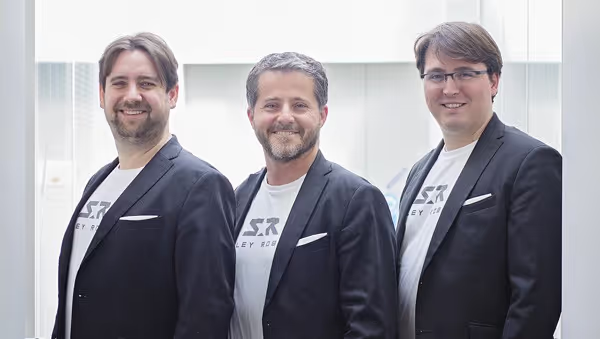
The idea of working with Aurélien, the CTO, and Clément, the CEO, came about because Stéphane could provide them with the business perspective they were lacking.
Recruit the first candidates
Recruiting was a challenging process for Stanley Robotics. The founders’ lack of recruitment experience made it difficult for themto identify the right candidates for the startup based on its needs.
They have now developed a recruitment strategy. They have defined a set of values and put them into practice every day. These values have become their guiding principles for recruitment. For example, one of their values is “Own the company”: they give equity in the company to every new employee.
Finding a first paying customer right from the start, working with large corporations, or building a team are key factors that often hold back the success of innovative startups. Stanley Robotics was able to bounce back and refocus its vision by learning from its mistakes. It is thanks to this agility that the company has become one of the most notable success stories among French innovative startups in just a few years.
Related articles

Sébastien Deschaux

Serial entrepreneur, engineer, incorrigible scientist, innovation enthusiast, Lean Startup expert, and advocate for a better world. My job is simple: to turn innovative project ideas into profitable, high-growth businesses. To do this, there’s no better strategy than honing the value proposition until customers can’t wait to buy. Then, it’s 100% action: selling, convincing, developing, delivering, and moving forward. For project leaders, working with me can be challenging. But it also guarantees lightning-fast progress and prevents you from spending years of your life just getting by without making any headway on a project.