
Securing Your CIR/CII: The Basics You Need to Know
How can you secure the Research Tax Credit (CIR) and/or the Innovation Tax Credit (CII)? Below are the key steps to obtaining the CIR/CII for your projects, filing your claim with the tax authorities, and preparing for a tax audit. For other funding opportunities for innovative projects, also discover best practices for securing funding.
What are the CIR and the CII?
The Research Tax Credit (known by the acronym CIR) is a French program designed to support Research & Development (R&D) for businesses. It significantly reduces the cost of R&D investments, whether they involve personnel expenses, subcontracting, or technology monitoring.
Available to all companies, with no equity requirements, the CIR is equal to 30% of R&D expenses incurred during a calendar year. Claimed when filing tax returns, it reduces the amount of corporate income tax (IS) or may be refunded by the tax authorities if the CIR exceeds the IS.
For an SME that designs and develops an innovative product, the Innovation Tax Credit (commonly known as the CII) may also be claimed. With a potential value of up to €80,000 per year, the CII is an ideal alternative for innovative companies that lack the necessary structure to conduct R&D work.
Key steps for obtaining and securing the CIR
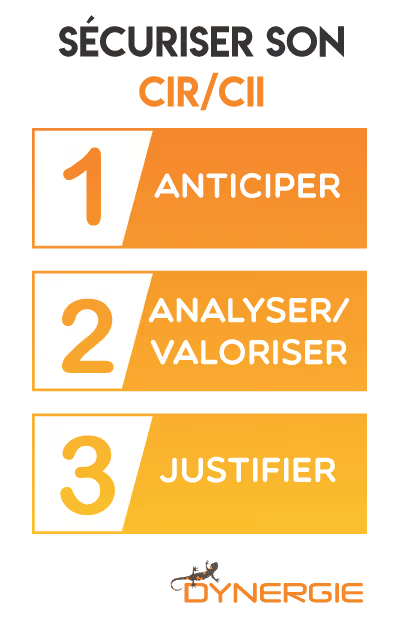
A) PLAN AHEAD
1 – Verify the scientific eligibility of projects: R&D? Innovation? Other…
The first requirement for eligibility for the CIR and/or CII is to carry out work classified as R&D or innovation. To verify this, it is essential to refer to the definitions adopted by the tax authorities, which are based on the Frascati Manual and the Oslo Manual.
To put it simply, we can say that:
- R&D is characterized by a scientific approach aimed at resolving technical uncertainties and advancing the general state of knowledge.
- Innovation involves designing and prototyping a new product with the aim of improving performance compared to existing market offerings.
Verifying a project’s eligibility for the CIR or CII is therefore the first step toward a successful filing!
2 – Get an official ruling through a tax ruling!
Directly related to Step 1, a tax ruling is the ideal tool for officially confirming the eligibility of your projects even before you file them!
The advance ruling process involves submitting a proposal to the tax authorities for their review. An official response is provided within three months, clearly stating whether the proposal qualifies for the CIR or the CII.
In addition to securing your CIR/CII, the advance ruling will simplify matters in the event of a tax audit, since the tax authorities will not need to seek a new scientific opinion. This saves you time, stress, and money!
3 – Implement a time-tracking system
Accounting for more than 50% of reported expenses, personnel costs are the largest component of the CIR and CII. It is therefore essential to accurately quantify them!
Accurate tracking of time spent, by person and by project, is essential, and plans for implementing it must be made early on, right from the start of projects.
B) PROMOTE
4 – Calculate your CIR and/or CII
The rules for calculating the CIR and CII are very specific and must be followed to the letter to avoid the risk of a tax adjustment in the event of a tax audit.
The first step is to identify the so-called “eligible” expense categories.
In fact, only certain R&D or innovation expenses may be taken into account when calculating the amount of the tax credit to be claimed.
There are:
- Specific categories of eligible expenses
Example: Equipment (depreciated for accounting purposes) is eligible, but consumables (expensed) are not - Specific rules must be followedfor each category
Example: New equipment is eligible, but used equipment is not.
Next, you must apply the current calculation rules to account for each expense item.
In particular, there are adjustments or caps on certain expenses, as well as items calculated on a flat-rate basis, such as operating costs, for example.
Finally, a rate of 30% is applied to the total amount of eligible R&D expenses to calculate the CIR amount. Under the CII, the applicable rate is 20%, with an annual maximum of €80,000.
5 – File your CIR and/or CII
Once the calculation has been completed, it must be submitted to the tax authorities.
This is done at the end of the fiscal year, when you file your tax returns, using Form No. 2069-A.
For small and medium-sized businesses whose tax credit exceeds their corporate income tax liability, a refund request can be submitted using Form No. 2573!
C) JUSTIFY
6 – Justify your CIR / CII
In addition to filing the return, it is essential to prepare all supporting documentation related to the CIR/CII in order to respond to any requests from the tax authorities:
- An administrative and financial dossier providing a detailed breakdown of the calculations and expenses included: resumes, time spent per project and per person, depreciation schedules, invoices, pay stubs, etc.
- A scientific and technical report demonstrating the R&D or innovative nature of the selected projects: state of the art, scientific challenges to be overcome or performance targets, scientific approaches taken, results and progress achieved…
7 – Preparing for a tax audit
When you apply for the Research Tax Credit and/or the Innovation Tax Credit,
the tax authorities reserve the right to verify your returns through a tax audit.
It is therefore essential to plan ahead for a tax audit and prepare the supporting documentation for your CIR/CII return well in advance; otherwise, you may be unable to meet the auditors’ expectations and risk facing a tax assessment.
Related articles

Lauriane Novac

I am passionate about the industrial sector and related fields. I advise and support companies of all sizes and across all industries in the strategic and financial development of their innovations. Beyond innovation projects, what motivates me even more in carrying out my work is the relationships I build with my clients and the mutual enrichment that comes from them.