How Deep Tech Funds Support Financing for Technological Risk
The full podcast
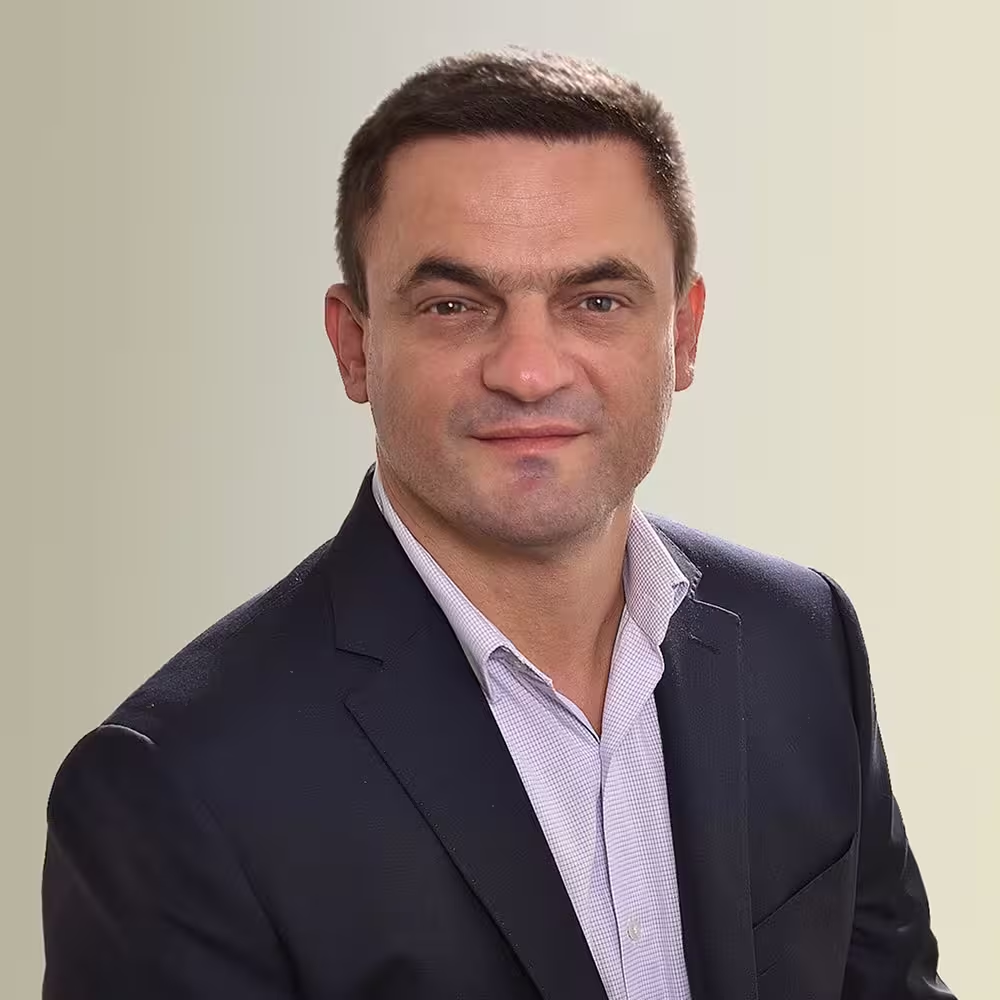
Jean-Philippe Zoghbi
Non-dilutive financing provides significant leverage. In the case of the Pertinence Invest fund, an investment of 30 million euros resulted in 300 million euros in total financing.
A pioneer in the French venture capital industry, Jean-Philippe Zoghbi has over 20 years of experience in financing innovation. As a former executive at I-Source, he witnessed the emergence of the French tech ecosystem following the passage of the Allègre Law.
Today at UI Investissement, he leads Pertinence Invest, a unique investment vehicle that forges close ties between the academic world (engineering schools), industry, and entrepreneurs. His specialty: turning public research into industrial success stories (Deeptech) by mitigating the risks associated with the seed funding phase.
Program Summary
The Origins of Innovation Funding in France
The current deep tech ecosystem has its roots in the 1999 Allègre Law, a legislative breakthrough that allowed public-sector researchers to commercialize their work through private entrepreneurship.
This period marks the shift from siloed basic research to a focus on technology transfer.
The first seed funds, which started out with modest capital, had to evolve to support projects requiring lengthy and costly R&D cycles, thereby shaping the venture capital market as we know it today.
The uniqueness of the "Deeptech Fund" industrial model
Unlike digital startups (SaaS, marketplaces), whose growth metrics are standardized, deep tech startups—particularly those in the industrial sector (hardware, chemicals, materials)—operate on different cycles. Financing these projects requires more than just an injection of capital; it necessitates building a supportive ecosystem.
The challenge is to finance not only the proof of concept (POC), but above all the "journey through the Valley of Death" all the way to the first production facility or market entry, by accepting a level of technological risk that generalist funds often refuse to take on.
Co-investment Strategy and Corporate Venture
To identify disruptive technologies, specialized funds are now structuring their investment vehicles to directly include industry partners (LPs) and academic institutions.
This approach makes it possible to validate market relevance well before launch ("Market Pull" vs. "Tech Push").
The involvement of major corporations (such as Michelin or Seb) goes beyond mere financial support: it provides a real-world testing ground and accelerates commercialization, helping startups avoid the pitfall of short-lived proof-of-concepts.
The leverage effect of non-dilutive financing
In the financial structure of an industrial startup, equity (opening up the capital) is just one building block.
A project’s competitiveness depends on its ability to leverage non-dilutive financing sources: bank loans, regional grants, Bpifrance grants, or European grants (EIC).
A healthy leverage ratio allows a company to amplify the impact of its equity (up to 10 times), thereby preserving the founders' stake while financing the capital expenditures (CAPEX) needed for reindustrialization.
Resilience and Economic Cycles
Investment in innovation is subject to macroeconomic cycles (the 2008 crisis, COVID-19, geopolitical instability).
After a period of abundant liquidity, the market is tightening, requiring greater selectivity.
This streamlining favors projects with significant social and environmental impact (decarbonization, circular economy) that are supported by viable business models, at the expense of companies that are "on life support" and cannot demonstrate a clear path to profitability.
Deep In Tech by Dynergie
Deep in Tech is driven by a core belief: to understand Deeptech, you have to listen to the people who are building it.
Behind every disruptive innovation lie demanding journeys, difficult trade-offs, and successes that often go unrecognized.
The podcast gives a voice to entrepreneurs, researchers, investors, and industry leaders at the intersection of science and the market.
At the heart of the Deeptech ecosystem’s challenges, Deep in Tech lifts the veil on the behind-the-scenes of a world as complex as it is strategic. Industrialization, financing, the transition from lab to market…
These journeys, often fraught with obstacles, are recounted candidly by those who experience them firsthand.
The podcast offers an authentic look at the inner workings, tensions, and collaborations that shape both the successes and failures of French Deeptech.
A space to understand the reality on the ground, from the perspective of those involved, far from formulaic narratives.

Florence Caghassi Jouni
With Deep in Tech, I meet the people who are shaping the deep tech landscape every day. They share their journeys, struggles, challenges, and successes with me—unfiltered. I created this podcast to help everyone understand and navigate the complex and exciting ecosystem that is deep tech.









Check out our other podcasts
Follow us on various streaming platforms: