
Guide to the Statutes of Young Innovative Companies: JEI, JEIC, JEIR
The "Young Innovative Company" status plays a key role in the landscape of French support programs for young innovative SMEs. Although these programs may seem complex, this article will guide you in choosing the right status by detailing their eligibility requirements, advantages, and benefits, as well as the specific features of each program.
What is the Innovative Young Company status?
The "Young Innovative Company" program is a status designed for young small and medium-sized enterprises (SMEs) that make significant investments in research and development and, in return, benefit from reductions in their tax and social security contributions.
Through this initiative,the French government aims to promote the creation and growth of innovative companies in France.
What are the different categories of “Young Innovative Company”?
Historical status "Young Innovative Company" (JEI) has existed since 2004. The 2024 Finance Act expanded this program to include two new statuses: the JEIC (Young Innovative Growth Company), intended for high-growth tech startups, and the JEIR (Young Disruptive Innovative Enterprise), designed for deep tech companies.
It should be noted that there is also the JEU (Young University Enterprise) status, which offers simplified eligibility requirements specifically for companies spun off from university research. The JEU program aims to encourage the commercialization of academic research and facilitate technology transfer between universities and the business world.
Innovative Young Company (IYC)
The JEI status is available for 11 years for companies established between January 1, 2014, and December 31, 2022, or for 8 years for those established after February 1, 2023. It is open to all SMEs as defined by the European Union that meet the following conditions:
- Created from scratch
- At least 50% ownership by individuals, other young innovative companies, public-interest associations or foundations, public research and educational institutions (and their subsidiaries), investment companies, etc.
- More than 20% of R&D spending (starting in 2025)
A young innovative company (JEI) is eligible forbenefits designed to preserve its cash flow, facilitate hiring, raise funds from private investors, access government contracts, and receivetax exemptions.
Young Innovative Growth Company (JEIC)
The JEIC status has the same eligibility criteria, with the following exceptions:
- R&D spending must be between 5% and 20%
- The company's R&D expenditures must not have decreased compared to the previous fiscal year
- The number of employees must have increased by at least 100% (and by at least 10 FTEs) compared to the fiscal year three years prior (The company must therefore have been in operation for at least three years to qualify as a JEIC)
A JEIC enjoys the same benefits as a JEI, except for tax exemptions.
Young Innovative Disruptive Company (JEIR)
The JEIR retains the same eligibility criteria as the JEI, but requires R&D expenditures to exceed 30%. In return, individuals can invest in it under more favorable terms.
Comparison of the Statutes for Young Innovative Companies: JEI, JEIC, JEIR
Eligibility Criteria

* The company’s R&D expenditures have not decreased compared to fiscal year N-1 AND its workforce has increased by at least 100% (and at least 10 FTE) compared to fiscal year N-3 (The company must therefore have been in operation for at least 3 years to qualify as a JEIC)
Benefits & Perks
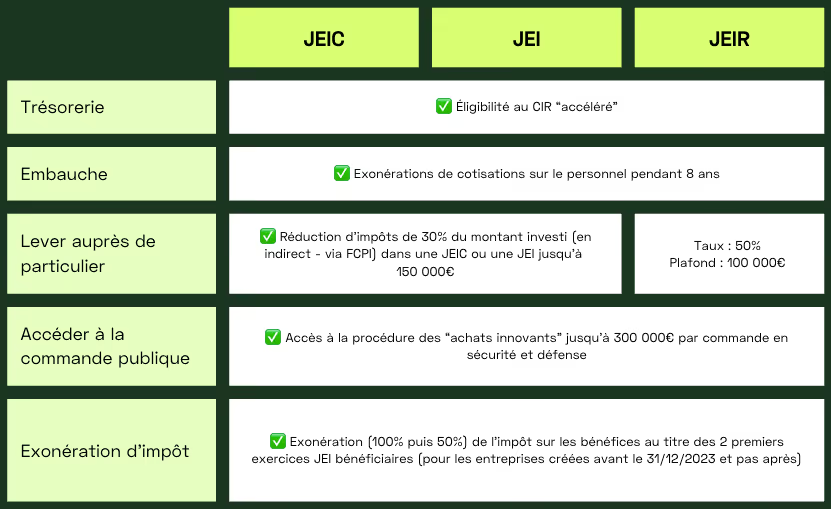
The Accelerated Research Tax Credit (CIR) is an experimental measure (provided for in the 2024 Finance Act) that allows Young Innovative Enterprises (JEI), Young Innovative Commercial Enterprises (JEIC), and Young Innovative Research Enterprises (JEIR) to receive an early refund of their research tax credit within a period reduced to one month, instead of the longer standard period (several months, or even more than a year in some cases). Early refund of the CIR tax credit.
There are other benefits that you can find on the next page of the“Entreprendre Service Public”website
How to Qualify for Innovative Young Company Status?
When you start your business:
- If you are a deep-tech company looking to raise funds with R&D expenses exceeding 30% and you meet the eligibility requirements, JEIR status offers significant advantages.
- If your R&D expenses exceed 20% and you meet all eligibility requirements, JEI status will allow you to benefit from the advantages listed above.
As your company grows, if you are a JEIR and your R&D expenses fall below the 30% threshold (but remain above 20%), switching to standard JEI status will allow you to take advantage of its benefits.
Similarly, if you are a JEI (regardless of whether you were previously a JEIR), your company is more than three years old, and—for example—you are entering a phase of business acceleration with R&D expenses of less than 20%, JEIC status will be beneficial for your company (provided you meet the eligibility requirements).
It is important to note that the company must regularly verify its compliance with the eligibility requirements for the various tax statuses each year, even after obtaining them through an advance ruling.
Pour sécuriser cette démarche, faire appel à un cabinet de conseil spécialisé en financement de l'innovation comme Dynergie permet d'être accompagné par un expert dans la vérification des critères (détention du capital, dépenses en R&D, croissance des effectifs pour le JEIC, etc.)
What is the official ruling on the articles of incorporation for a Young Innovative Company?
The JEI ruling is a procedure that allows a company to clarify its status with the tax authorities. Specifically, the company may request that the tax authorities rule on its eligibility for JEI, JEIC, or JEIR status.
This approach has several advantages:
- Legal certainty: the tax authority cannot later challenge its position if it has already approved the eligibility
- A prompt response: the government must respond within 3 months of receiving a complete application
- A free process that can be completed at any time
How do you qualify for Young Innovative Company status?
To qualify for the status of "Young Innovative Company," the company must:
- Self-assessment: verify that you meet all the eligibility criteria for the desired status (JEI, JEIC, or JEIR)
- File a tax return with the tax authorities by the deadline for reporting income
- Submit a request for a ruling (optional but recommended) to ensure your compliance
- Notify URSSAF to qualify for social security contribution exemptions
The company must also make available to the authorities all documents proving that it meets the required conditions, including:
- A technical report describing its R&D projects
- The accounting items detailing the calculation of R&D expenses
- Documents relating to ownership of the capital
Il est recommandé de se faire accompagner par un expert comme Dynergie pour constituer ces dossiers et optimiser ses chances d'obtention du statut.
Related articles

Damien Villiers-Moriamé

I assist innovative companies of all sizes in securing public funding (CIR-CII, JEI, bpifrance, CIN, etc.). My technical expertise spans a variety of fields, including IoT, AI, e-learning, embedded systems, and service robotics. My daily work involves supporting entrepreneurs through key and critical stages of their projects (developing a financing plan, creating a business plan, and validating the business model).