
Generative AI: A Guide for Small and Medium-Sized Businesses
Dive into the world of generative artificial intelligence and discover how it is reshaping the landscape for small and medium-sized businesses. This article highlights key strategies for leveraging generative AI to overcome concerns and unlock its potential for innovation and growth.
In a world where technology is evolving at a breakneck pace, generative artificial intelligence (Gen AI) is emerging as an unstoppable revolution for businesses of all sizes. Its potential to transform work methods, drive innovation, and create new opportunities is undeniable.
However, despite its promise, the adoption of generative AI raises many concerns among leaders of small and medium-sized businesses. These concerns, often linked to the perceived complexity of the technology, financial implications, the impact on employment, and data security issues, represent major barriers.
However, it is crucial to understand that generative AI is not solely the preserve of large companies with substantial resources. It is also accessible and beneficial to small and medium-sized businesses, provided that a thoughtful and informed adoption strategy is put in place. This article aims to demystify generative AI by addressing common concerns in a transparent and informed manner and providing strategies to overcome them.
As leaders and decision-makers, this article will show you how this content creation technology can be an ally in your pursuit of innovation and competitiveness—not a cause for concern.
Join us on this journey to uncover the world of generative AI, understand its transformative potential for your business, and begin the path toward successful and secure adoption.
Some definitions - What are the different categories of AI?

What does the term "AI" mean?
Artificial intelligence (AI) is the umbrella term that encompasses all other categories of AI. It refers to the set of theories and techniques used to create machines capable of simulating human intelligence. AI is the dream of replicating human cognitive abilities: learning, understanding, reasoning, and even feeling.
What is machine learning?
Machine learning is a subfield of AI that focuses on the ability of machines to learn from data. Instead of explicitly programming a computer to perform specific tasks, it is taught to learn from experience. A classic example is email filtering (spam vs. non-spam) based on pattern recognition in incoming messages.
What is deep learning?
Deep learningis a subset of machine learning that uses deep artificial neural networks. These networks are inspired by the structure and functioning of the human brain and are capable of learning to perform tasks by processing large amounts of data. A prime example is facial recognition, where the system learns to identify and distinguish human faces with astonishing accuracy.
What is generative artificial intelligence (Gen AI)?
Generative artificial intelligence (AI) is a branch of AI that focuses on creating new and original content, ranging from text generators to image generators, music, and beyond. Unlike traditional AI, which is often limited to analyzing and interpreting data, generative AI learns from vast existing datasets to produce original creations.
What does the term "LLMs" mean?
LargeLanguage Models(LLMs), such as ChatGPT, are specific types of generative AI designed to understand and generate text. These models are trained on massive text corpora to predict the next word in a sentence, enabling them to generate coherent and contextually relevant text.
How does generative AI work?
Large language models (LLMs) such as GPT (Generative Pre-trained Transformer) and related generative AI tools construct their responses by using probability generators to predict the next word in a sequence of words, based on the context provided by the preceding words. They utilize massive computational power to provide the most appropriate responses.
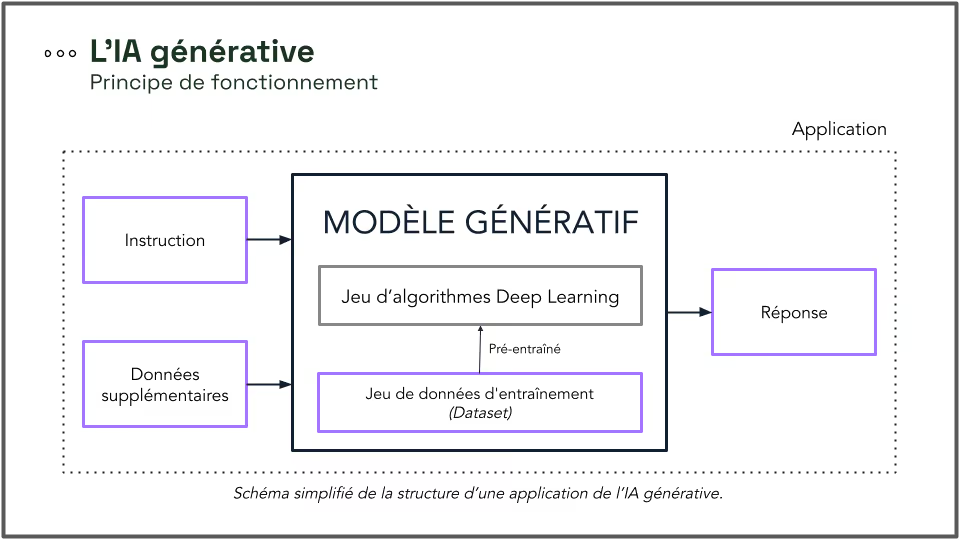
- Prompt: Also known as a prompt. This is the initial request or problem that the AI must solve, such as generating a specific text or image.
- Generative model: At the heart of the system, it relies on pre-trained deep learning algorithms to process instructions and data.
- Training data (dataset): This refers to the data previously used to teach the model how to perform its tasks. The larger and more varied the dataset, the more accurate and relevant the model’s responses will be.
- Additional data: This refers to supplementary information provided to refine the task requested of the AI as input data. This could be a link to a website, an image, or a PDF document, for example.
- Answer: The output generated by AI, whether it is text, an image, or another form of content.
What are the main models?
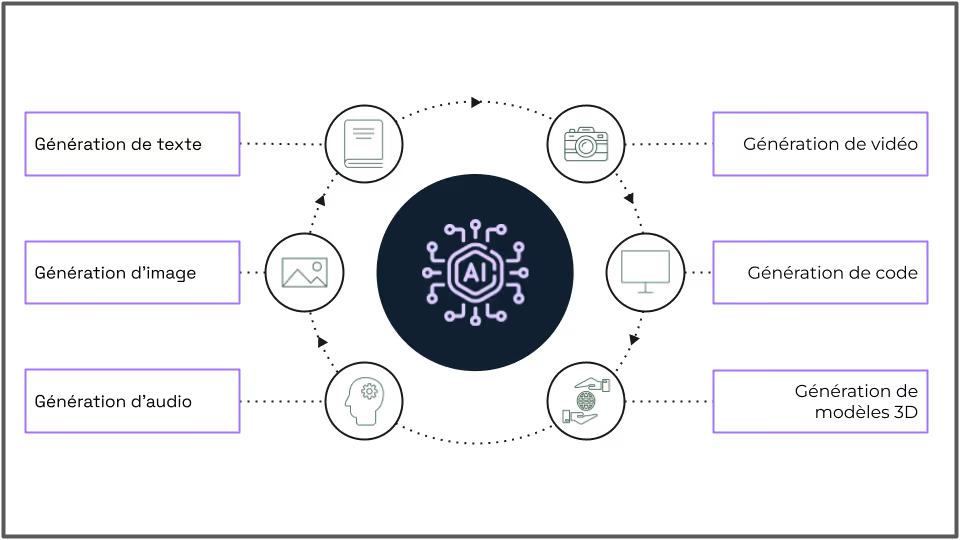
There are six main types of generative AI:
- Text generation
- Video generation
- Image generation
- Code generation
- Audio generation
- 3D Model Generation
Whatare the best generative AItools? List of the top AI tools on the market
Several generative AI tools on the market stand out for their effectiveness and accessibility, thanks to sophisticated algorithms. ChatGPT, developed by OpenAI, uses cutting-edge algorithms and has gained widespread recognition for its ability to generate complex text responses. Midjourney, meanwhile, leverages advanced algorithms to specialize in creating high-resolution images based on textual descriptions.
Text generators
- GPT-4 by OpenAI, the most powerful model on the market today
- Anthropic's Claude 3, which comes close to GPT-4 in terms of performance but is not currently available in France
- Microsoft Copilot, which integrates with the Office suite
- Google Gemini
- Llama 2, Meta's AI
- Mistral 7B by Mistral AI, an open-source French startup.
Image generators
- Midjourney V6, developed by the American research lab Midjourney, is the most powerful generative AI tool for images and graphic design on the market today
- OpenAI's DALL·E 3
- Stable Diffusion by Stability.AI
- Adobe Firefly, the most user-friendly option with a wide range of tools (text-to-image; generative fill; generative recoloring; text-to-vector image, etc.)
Video generators
- Runway Gen-2 is a generative AI model for animating images
- Pika, an animated text-to-video model
- OpenAI's Sora, currently in development, can generate a stunning video lasting just a few seconds from a simple prompt
Examples of practical applications of generative AI in business
- Daily tasks: AI can draft or summarize emails, take notes, and write meeting minutes, thereby reducing the administrative burden on teams.
- Customer service: AI handles customer inquiries, analyzes data to improve the customer experience, and can even provide virtual assistants
- Marketing: It creates advertising messages, optimizes customer segmentation, and personalizes campaigns for more effective targeting. It can also be a valuable tool for content creation and image generation.
- Sales: AI develops sales scenarios, crafts sales pitches, and personalizes communications with customers, helping to improve lead conversion rates.
- Human Resources: AI can streamline tasks such as automating the screening of applications, personalizing training programs, and drafting job postings.
- Innovation: By fostering creativity, identifying innovative opportunities, accelerating testing cycles, and improving strategic decision-making, generative AI is a driver of innovation.
Debunking the main obstacles
Perceived complexity
One of the main concerns surrounding generative AI is how complex it appears to be. Executives are asking themselves: Do you need to be a data expert to adopt this technology? The answer is reassuring: no. Thanks to increasingly intuitive tools and targeted training, AI is becoming accessible even to non-specialists. Awareness programs help dispel apprehensions, highlight key AI features that can be seamlessly integrated into organizational processes, and identify AI applications.
Capital expenditure
The cost may seem prohibitive at first glance, but investing in generative AI should be viewed as a long-term strategic investment. Indeed, gains in productivity, efficiency, and the creation of new offerings pave the way for a significant return on investment. Adaptive solutions are available, ranging from the most cost-effective options that leverage existing tools to custom-built solutions that can be phased in over time to align with the investment capabilities of small and medium-sized businesses.
Fear of being replaced
This is one of the most common ethical questions; the idea that AI could replace employees is a common misconception. Rather than replacing humans, generative AI is designed to augment and expand human capabilities. It handles repetitive or complex tasks, freeing up employees for higher-value activities that require creativity and human judgment. It is a complementary relationship that strengthens teams, rather than a competitive one that threatens them.
Data security on generative AI tools such as ChatGPT or Google
In an era where data is valuable, its security is a top priority. Adopting generative AI does not mean neglecting privacy. By choosing reputable providers that do not train their algorithms using company data (a key point to verify) and by implementing robust cybersecurity practices with their security teams, companies can reap the benefits of AI while protecting their sensitive data. Specific training programs can also help organizations understand and manage data security risks.
The implementation of an AI usage policy is a decisive step toward ensuring data security, particularly by following the European Union’s recommendations. This policy serves as a set of guidelines that clearly define how and for what purposes data may be used by generative AI.
By examining these obstacles, we see that each one can be overcome with a well-thought-out strategy and the right tools. The key is to start with small, measured steps, adopt a continuous learning approach, and focus on the growth potential that generative AI can unlock for small and medium-sized businesses.
Benefits of Adopting Generative AI for Small and Medium-Sized Businesses
Increased efficiency
Automating repetitive tasks using AI helps reduce human error and boost productivity. For example, automating customer relationship management and after-sales services allows companies to handle a higher volume of requests without compromising service quality.
Product/Service Innovation
The adoption of generative AI opens up entirely new possibilities in product and service design. It enables the exploration of options that were previously unimaginable, such as real-time personalized products or highly responsive customer service powered by intelligent chatbots. With AI, companies can not only improve their existing offerings but also create new ones, leveraging data to anticipate customer needs and respond proactively.
Competitive advantage
SMEs and mid-sized companies that adopt generative AI have a clear advantage over competitors who stick to traditional methods. AI can identify hidden market trends, anticipate consumer demand, and personalize offerings, thereby helping companies position themselves as market leaders.
The adoption of generative AI is therefore not about following a trend, but a strategic move toward a more resilient, innovative, and competitive business. By highlighting these benefits, we can inspire leaders to take the next step toward the future of AI.
First step toward the adoption of generative AI
For small and medium-sized businesses and mid-market companies ready to explore generative AI, the path to adoption may seem fraught with uncertainty. However, with a structured approach and experienced partners, the first steps in this digital transformation can be taken with confidence and efficiency.
Awareness and Training in Generative AI
Adopting AI starts with a clear understanding of what the technology can offer. At Dynergie, we have developed awareness and training programs to help businesses become familiar with AI. Our events, conferences, and webinars are designed to dispel myths and demonstrate the practical benefits of generative AI. We also offer specialized training on tools such as ChatGPT and on developing specific agents, empowering businesses to take control of their digital transformation.
Identification of relevant use cases
For AI adoption to be successful, it must be relevant to the company’s current operations. This requires a thorough assessment of existing processes and the identification of internal and customer use cases where AI could have the most significant impact. At Dynergie, we support companies through this crucial stage by conducting workshops and design sprints to uncover innovative solutions powered by AI.
Development and implementation of AI tools
Identifying the right tools for implementing AI is essential. Whether through the use of existing tools or the development of specific agents, each company must find the approach that works best for it. Initial testing is essential for gathering feedback and refining solutions. Dynergie is committed to providing expert guidance on selecting tools, customizing them, and integrating them into companies’ existing operations.
Implementation and support
The implementation of a generative AI system does not end with the deployment of the tools. Ongoing support is crucial to ensuring a seamless integration into daily work practices. Tailored employee training, rigorous project management, and change management consulting are all services that Dynergie provides to ensure that the adoption of AI generates sustainable added value.
These initial steps toward adopting generative AI are steps toward a future where innovation and efficiency are the keys to success. With the right support and resources, small and medium-sized businesses can turn generative AI into a major asset for their growth and competitiveness.
Conclusion
The adoption of generative AI by small and medium-sized businesses is less a matter of following a trend and more a fundamental transformation necessary to remain competitive in an ever-changing world. The benefits are clear: increased efficiency, advanced innovation, and a significant competitive advantage. However, concerns about complexity, cost, job displacement, and data security can hinder the move toward this cutting-edge technology.
At Dynergie, we have demonstrated that these obstacles can be overcome. By focusing on awareness-raising, training, identifying relevant use cases, and personalized support, we have made generative AI not only a practical reality but also a driver of growth and innovation. Far from replacing humans, the adoption of this technology amplifies human capabilities and opens the door to unexplored horizons.
We invite you to view generative AI not as an insurmountable challenge, but as an exciting opportunity. The era of generative AI is here, and it is accessible to all companies ready to embrace change and invest in their future. Now is the time to be part of this revolution, and Dynergie is here to guide you through it.
So, take a moment to think about it: how could generative AI transform your business?
To learn more about our AI offerings: https://www.dynergie.fr/sous-offres/integrer-lia-dans-votre-entreprise
If you would like to contact us: https://www.dynergie.fr/equipe
Related articles

Johan Putters

AI Expert | Corporate Innovation Accelerator | Head of the Pre-Seed Fund and Startup Studio La Fabrique à Pépites