
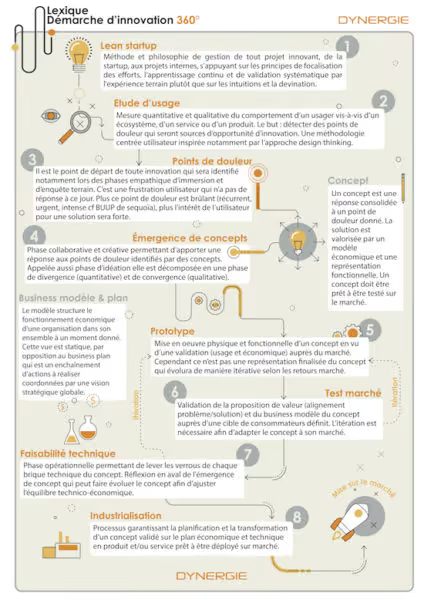
Infographic: Innovation Glossary—A Comprehensive Approach
Have you ever found yourself in a meeting where you pretended to understand what was being said?
The world of innovation has its own vocabulary, which can be tricky but necessary to master. In a fast-paced environment, there’s no room for misinterpretation.
For those unfamiliar with the field, the use of technical jargon can be a source of frustration. Misunderstandings have often caused us difficulties during our projects. Indeed, an innovation project is a major undertaking for all stakeholders, so it is essential to facilitate open communication and demystify our professions.
Having analyzed this risk, we have now adopted an acculturation approach that enables our partners to grasp the fundamental terminology of our processes. Knowing how to self-assess, identify one’s weaknesses, and move forward is a principle we strive to apply every day.
It’s up to you to embrace this new approach and become a source of knowledge. To help you do so—beyond the many existing definitions—here is an introductory infographic on the vocabulary of innovation that will help you understand the concepts specific to our comprehensive innovation approach.
Lean Startup:
A management approach and philosophy for any innovative project—from startups to internal initiatives—based on the principles of focusing efforts, continuous learning, and systematic validation through real-world experience rather than intuition or guesswork.
Read our article “Rapid Innovation Is Possible Thanks to the Lean Startup Approach”
Usage study:
A quantitative and qualitative assessment of user behavior toward an ecosystem, service, or product. The goal: to identify pain points that can serve as opportunities for innovation. A user-centered methodology commonly used in the design thinking approach.
Pain point:
It is the starting point for all innovation and will be identified, in particular, during the empathy-driven phases of immersion and field research. It is a user frustration that currently has no solution. The more pressing this pain point is (recurring, urgent, intense), the greater the user’s interest in a solution will be.
Emergence of concepts:
A collaborative and creative phase designed to address pain points identified through concepts. Also known as the ideation phase, it is divided into a divergence phase (quantitative) and a convergence phase (qualitative).
Concept:
A concept is a well-defined solution to a specific pain point. The solution is supported by a business model and a functional design. A concept must be ready for market testing.
Business Model and Business Plan:
A business model outlines how an organization operates economically as a whole at a given point in time. This is a static view, in contrast to a business plan, which is a sequence of actions to be carried out, coordinated by an overarching strategic vision.
Prototype:
The physical and functional implementation of a concept for market validation (both in terms of usability and economic viability). However, this is not a final version of the concept, as it is intended to be adaptable.
Market test:
Validation of the concept’s value proposition (problem-solution alignment) and business model with a defined target consumer group. Iteration is necessary to adapt the concept to its market.
Technical feasibility:
An operational phase designed to resolve the technical challenges associated with each component of the concept. This phase follows the concept development stage and may involve refining the concept tooptimize the technical and economic balance.
Industrialization:
A process that ensures the planning and development of a concept that has been validated from both an economic and technical standpoint into a product and/or service ready for market launch.
Related articles

Sophie Joliet
