
How should a startup accelerator program be structured?
This article takes an in-depth look at what an accelerator program is, its importance for startups, how it works, and how it can be structured to maximize its effectiveness.
What is an accelerator program?
Definition and Objectives
An accelerator program is a support program designed to help early-stage startups scale up. It is often a short, intensive program where entrepreneurs and their teams receive coaching, mentoring, technical resources, funding, and access to a network of contacts (entrepreneurs, venture capitalists, experts, etc.). The main goal of accelerators is to accelerate the development of startups, their products, or solutions, and to facilitate market access in a short timeframe.
What is an incubation program?
The goal of an incubation program is to provide long-term support to early-stage startups. These programs help entrepreneurs and their teams turn their projects into reality by transforming their ideas into viable, functional business models. Unlike accelerators, incubators provide resources over a longer period of time, allowing for more gradual growth without the intense pressure of tight deadlines.
Incubator or Accelerator?
The main difference between these two support programs (incubators and accelerators) lies in the nature of the support provided and the stage of development of the startups—or innovative SMEs—and their leaders. Incubators are better suited for nascent ideas requiring initial development and refinement, while accelerators are designed for established companies seeking to accelerate their growth and rapidly enter the market. Accelerators also tend to offer intensive mentoring and funding in exchange for an equity stake in the company, which is less common in incubation programs.
Accelerator program: Who is it for?
Accelerator programs are ideally suited for companies with a minimum viable product (MVP) that are looking to refine their business model, expand their customer base, or attract investors. These support programs are particularly beneficial for entrepreneurs who are ready to commit fully and scale up quickly. Unlike incubators, accelerators are generally open to all companies, whether they are startups or innovative SMEs.
Why create an accelerator program?
The goal of launching an accelerator program is to stimulate innovation and contribute to the entrepreneurial ecosystem. For venture capitalists and economic development organizations, these programs provide a way to support the growth of startups, inject energy into the local economy, and identify future market leaders.
How does a startup accelerator make money?
Accelerators can generate revenue in a variety of ways, including equity stakes in the companies they accelerate, participation fees, or government grants. Equity investment, in which the accelerator receives a stake in the company in exchange for its initial investment and services, is particularly common.
Why do startups fail?
There are many reasons why startups fail, including a lack of market demand for the product, internal management issues, insufficient funding, lack of access to investors, or a poor market approach. A good accelerator program aims to mitigate these risks through its expertise, resources, and mentorship in areas such as marketing, business development, and financing. The goal is to strengthen the rocket’s foundation and enable it to take off, regardless of the thrust (whether hyper-growth or not).
How should you structure your program?
Developing an effective accelerator program involves clearly defining startup selection criteria, designing a robust roadmap, engaging high-quality mentors, and providing post-program support.
Flexibility to adapt to the specific needs of startups is also essential, as not all startups face the same challenges: assistance with fundraising, the need for international advisors to expand globally, establishing long-term partnerships with other ecosystem players, the need for significant funding for tech startups, the need for operational support, and so on.
A 3-step action plan
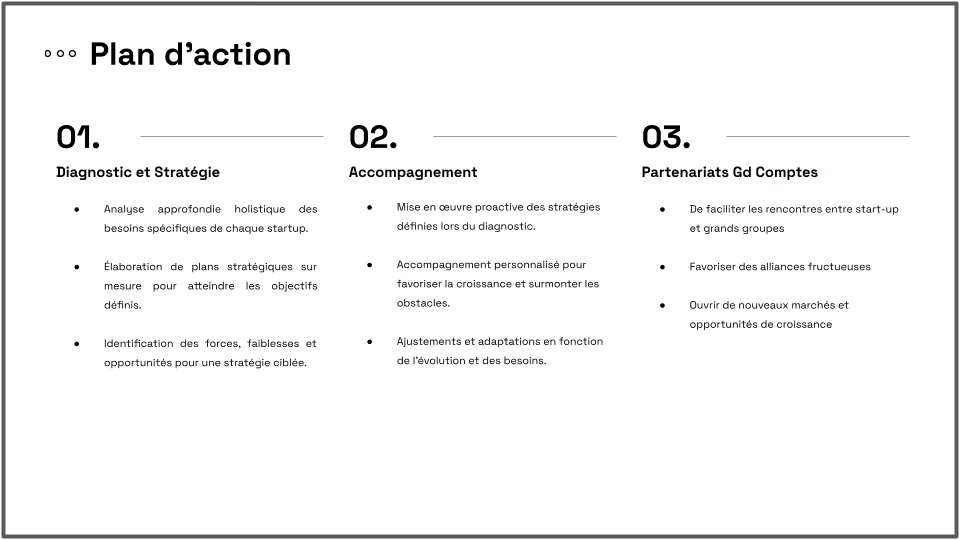
1. Diagnosis and Strategy
In this first step, it is essential to thoroughly analyze the specific needs of each startup you are supporting. You need to understand their strengths, any weaknesses they may have, and the opportunities available to them.
This detailed analysis will enable you, as an accelerator, to develop a strategy tailored to the specific circumstances of each startup and to create customized strategic plans that will help them achieve their goals efficiently and effectively.
2. Support
In this second phase of your assignment, your role is to provide personalized, tailored support to each startup, with the goal of fostering their growth and helping them overcome any obstacles that may arise.
This requires proactive and determined implementation of the various strategies identified during the initial assessment. However, this is not simply a matter of applying a standard formula. On the contrary, your role also involves demonstrating flexibility and adaptability, making adjustments and adaptations as the situation evolves and specific needs arise.
Be sure to surround your startups with industry experts, former entrepreneurs, and coaches so they can benefit from their experience, skills, and advice.
3. Key Account Partnerships
In the spirit of Open Innovation, foster collaboration between your startups and large corporations. These connections can lead to the formation of mutually beneficial partnerships, which can not only open up previously inaccessible markets but also create unprecedented growth opportunities. Your startups can thus benefit from the influence of established companies.
This networking process can serve as a powerful catalyst for driving innovation and growth in your startups.
Example: CleanTech Valley
CleanTech Vallée is an initiative that brings together local governments and private and public sector stakeholders in the Gard region, focusing on the momentum of the industrial green transition. Its goal is to focus on green innovation in areas such as carbon-free energy, green mobility, and the circular economy.
CleanTech Vallée is a prime example of a successful acceleration program that supports innovative startups and SMEs in the clean technology sector. By focusing on sustainable innovation, CleanTech Vallée helps selected companies grow by forging lasting partnerships with local businesses.
Key points of this support:
1. Des équipes motivées et alignées : pour nous à Dynergie, renforcer la motivation et l'engagement des membres de l'équipe est le meilleur moyen d'atteindre des objectifs communs. Cela assure également que tous les membres partagent la même vision et les mêmes valeurs, éléments cruciaux pour le succès et la croissance de tout projet ou entreprise.
2. Local partnerships: In addition to the obvious benefits for various stakeholders in learning to work together, these collaborations foster green innovation and knowledge sharing within a dynamic ecosystem that encourages experimentation and rapid adaptation.
Contribuer au rayonnement de la CleanTech Vallée et du programme Booster : l'innovation dans la cleantech est actuellement principalement portée par les régions Île-de-France et Auvergne-Rhône-Alpes, laissant peu de place aux autres territoires. Pourtant, ces territoires porteurs d'industries sont plus à même d'utiliser ces innovations. L'enjeu pour les équipes de Dynergie est donc de permettre à la CleanTech Vallée de rayonner et se positionner parmi les régions les plus attractives, afin d'attirer les talents et les entreprises à mission.
Dynergie, cabinet qui vous accompagne dans la structuration de vos programmes d'accélération
Dynergie se positionne comme un partenaire clé dans la structuration de programmes d'accélération. Avec une expertise approfondie et un réseau étendu, Dynergie aide les organisations à maximiser l'impact de leurs programmes, garantissant ainsi la croissance rapide et durable des startups innovantes.
Related articles

Matthieu PERRÉARD

Matthieu specializes in a wide range of sectors, including manufacturing, nuclear energy, and clean technology. He currently focuses on developing and implementing complex projects, bringing his diverse expertise in innovation strategy, entrepreneurship, design thinking, and lean startup to every initiative.