
Analysis: The Green Industries Tax Credit (C3IV)
As part of the Green Industry Bill, the Green Industry Investment Tax Credit (C3IV) supports eco-innovation projects.
From the Green Industry Bill to the 2024 Budget Act
The government’s Green Industry Bill and the 2024 Finance Bill (PLF) have introduced a number of changes to the landscape of innovation financing and the ecological transition. Among the key measures in the PLF is the new status JEIC, is the new tax credit for investments in Green Industry, better known by the acronym C3IV!
After a legislative process marked by numerous amendments, the bill was finally approved. Its adoption by Parliament was followed by its enactment on December 29, 2023 by the President of the Republic.
On January 8, the European Commission officially approved this state aid after verifying its compliance with European rules on state aid to businesses, under the “Temporary Crisis and Transition Framework.” This temporary framework (in effect until December 31, 2025) relaxes national rules on state aid to businesses in order to finance post-COVID recovery and the green transition.
As such, the C3IV, a particularly incentive-driven program, marks an important milestone in accelerating green reindustrialization in France toward a low-carbon economy.
This aid is expected to amount to 2.9 billion euros in public investment over the program’s duration, that is, through 2030.
C3IV: a tax scheme administered by the DGFIP and studied by ADEME
The C3IV aims to support investment in four key sectors of the green industry: the production of batteries, solar panels, wind turbines (onshore and offshore), and heat pumps.
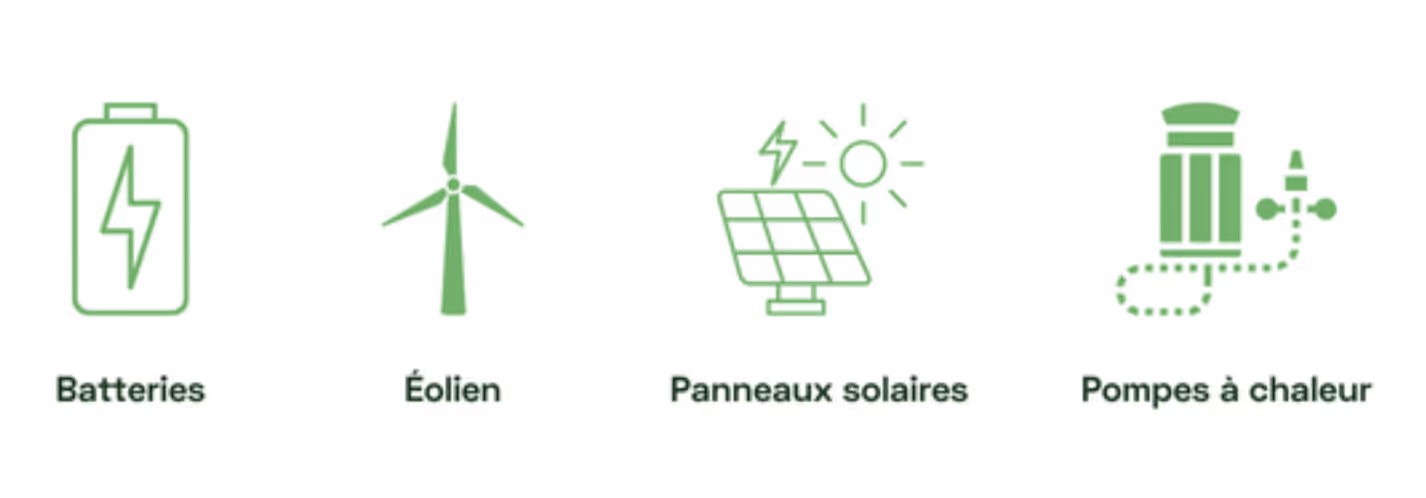
These sectors are essential for decarbonizing and greening our economy, bringing France into line with ambitious European environmental goals. Indeed, France aims to significantly increase the share of renewable energy in its energy mix, which cannot be achieved without massive investments in these technologies.
Other key sectors of the energy transition, such as the hydrogen sector and carbon sequestration, are more likely to be supported by the France 2030 funding plan through calls for projects, including: ADEME - Hydrogen Technology Building Blocks and Demonstrators. Of course, it is possible to combine multiple funding mechanisms to finance investments, provided that the same expense is not subsidized twice and subject to compliance with the funding caps (see below).
What are the rates and maximum amounts for the tax credit?
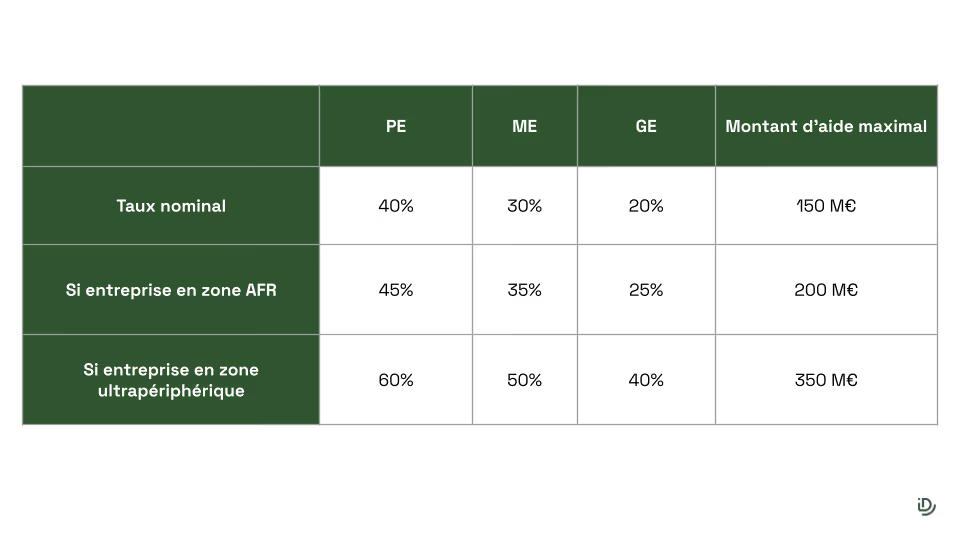
Eligible expenses under the C3IV are subsidized at a rate of 20% to 60%. More specifically, the base rate for this tax credit is 20%, but it can be increased to between 25% and 60% depending on the size of the business and its location. In fact,regional priority areas¹ (AFR) oroutermost regions²qualify for a higher rate.
The aid ceilings are set at 150 million euros per company, and may be increased to up to 350 million euros in certain cases.
The table below summarizes the rates and limits:
This program allows you to finance your tangible investments (such as buildings and equipment) and intangible investments (patent rights, know-how, etc.) related to the production of the green technologies mentioned.
This includes the essential components and critical raw materials needed to manufacture this equipment.
Eligibility: How do I know if I qualify for C3IV?
The process involves first applying for approval and then filing annual tax returns. The approval, issued by the Directorate General of Public Finances (DGFiP) and reviewed by the French Environment and Energy Management Agency (ADEME), validates the scope and eligible expenses of the company’s investment plan.
Once approval has been obtained, the company must calculate and report its tax credit annually, based on the actual expenses incurred during the year.
If the company is not subject to corporate income tax, it is possible to request a refund of the tax liability.
Eligible expenses are defined in tables listing eligible materials, components, and equipment. These tables may be further specified by decree. (https://www.impots.gouv.fr/credit-dimpot-au-titre-des-investissements-en-faveur-de-lindustrie-verte-c3iv)
Please note that the service for submitting accreditation applications has been available since September 2023 at the following address: (c3iv@dgfip.finances.gouv.fr). Its effective date has yet to be specified by decree.
What are the requirements for receiving this tax credit?
Like the CIR, the C3IV is a French tax incentive that must meet a set of strict requirements set by the government. Approval is contingent upon the submission of a solid and coherent investment plan. Criteria related to revenue, compliance with tax and social security obligations, and the relocation of business operations are in place.
In addition, the calculation must be performed annually and reported in the tax return, which may be subject to an audit.
Our expertise in tax and financial engineering ensures that your application for approval and your tax returns are prepared properly and that all regulations are strictly adhered to, thereby maximizing your profit potential with the C3IV.
By drawing onDynergie’s expertise, you can be sure to navigate this complex tax scheme effectively and make the most of this opportunity and how it interfaces with other financing options (bank, national calls for proposals, ADEME grants, Bpifrance, etc.).
Useful links:
> Analysis: The Research Tax Credit (CIR)
> Analysis: The Innovation Tax Credit (CII)
> Analysis: Innovative Young Company (IYC) Status
1 - Defined in Annex 1 of Decree No. 2022-968 of June 30, 2022
2 - Defined in Annex 2 of Decree No. 2022-968 of June 30, 2022 (Mayotte, French Guiana, Saint Martin, Guadeloupe, Réunion, Martinique)
Related articles

Damien Villiers-Moriamé

I assist innovative companies of all sizes in securing public funding (CIR-CII, JEI, bpifrance, CIN, etc.). My technical expertise spans a variety of fields, including IoT, AI, e-learning, embedded systems, and service robotics. My daily work involves supporting entrepreneurs through key and critical stages of their projects (developing a financing plan, creating a business plan, and validating the business model).