
Design Thinking: 11 Tools to Help You Put It into Practice!
Before launching your innovation project and using the Design Thinking method, you need to make sure your project has a solid foundation. If it doesn’t (and even if it does), I invite you to read our article “How to Make Your Innovation Project a Success Like No Other!” Design Thinking is one of the major trends in the world of innovation today. Some people can explain the method to you, but few are able to apply it correctly! In this article, you’ll find 11 practical tools that will help you put this method into practice and reap all its benefits.
Design Thinking: Key Takeaways
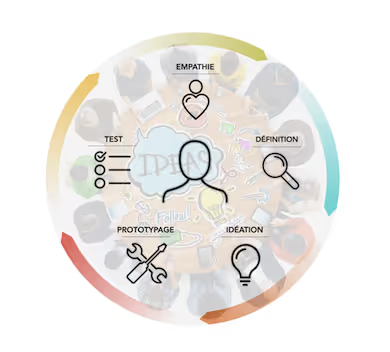
There are many definitions, each more complicated than the last… The only thing to remember about design thinking is that it involves creating an innovation that perfectly aligns with the user’s expectations. To do this, you simply need to follow a few basic principles:
- Build a team with members from different disciplines (Marketing, Design, R&D, etc.) and foster close collaboration among them.
- Spend time in the field, adopt the perspective of an ethnographer, and remain objective.
- Carry out multiple phases of creativity, following a divergence-convergence approach.
- Prototype, innovate incrementally, and test each new development.
- Always keep the end user at the heart of your project and use their feedback to achieve perfection!
The Design Thinking Toolkit
To implement these tools, you need to adopt a specific approach and develop expertise that can only be gained through practice. It is important to remember that these tools are part of an iterative process, so they will be used and refined throughout the project.
1. Stakeholder Map
Identify each component of your project’s ecosystem, and then identify the interactions between them. You need to define the scope of your project from the outset. This will give you a comprehensive overview and help you better understand how the various stakeholders function and relate to one another. It is important not to overlook any of them, as it will become increasingly difficult to incorporate them later on.
2. Map of Empathy
Based on your observations and interviews, identify your users’ thoughts, expectations, and feelings. Do the same for each stakeholder in the ecosystem. This initial phase of field immersion will help you better understand your users and identify their needs. It is essential to put yourself in their shoes in order to create an innovation designed for them—not for you!
3. User journey
Map out your users’ journeys while taking their feelings and emotions into account. Then analyze each step individually and identify all the associated pain points! The goal is to determine areas for improvement based on the current user experience so that you can then enhance it.
4. Hopes and Fears
Identify the team’s concerns and fears, as well as their expectations and aspirations regarding the project. This initial draft will help you assess the overall potential of your project and identify the key issues that need to be addressed. It’s helpful to keep this poster visible to everyone so that it can evolve throughout the project until all concerns have been addressed.
5. Idea Thumbnails
Generate as many "off-the-cuff" ideas as possible that address the identified pain points. Follow up this initial phase with brainstorming sessions to explore as many possibilities as possible.
Next, organize all the ideas based on pain points and refine them. Try to make the basic ideas more compelling and turn the “crazy” ideas into something feasible.
6. Use Case
To refine your ideas, put yourself in the user’s shoes, imagine various scenarios, and create the best possible experience for them.
7. Prioritization Matrix
Organize and prioritize your ideas based on various criteria, such as feasibility, market acceptance, company strategy, and any other factors you consider important.
It is essential that you spend time defining the criteria, as these are what will allow you to identify the ideas with the most potential.
8. Requirement Specifications
Reorient your approach and refocus your work on the end user by comparing the user’s needs —as identified through their initial pain points— with the benefits provided by the selected solutions.
The goal is to determine whether the selected ideas fully or partially address the issues identified during the previous phases.
9. Assumptions and Questions
Identify the assumptions that have not yet been verified, as well as those about which you still have doubts, and then prioritize them based on the risk they may pose.
The goal is to identify the critical assumptions that you need to verify in the field as soon as possible.
10. Feedback Form
Summarize and organize all feedback and new information from the field tests (what worked, what needs to be changed, new ideas, and unanswered questions).
This will allow you to finalize certain details and plan the next steps for the project.
11. Today, tomorrow, and the day after tomorrow
Build a "minimum viable product" using the best feasible ideas to plan for the short term.
Next, look ahead to the medium term with the ideas you need to refine, and finally, keep a long-term perspective with the ideas that inspire you but aren’t feasible right now.
No innovation without business!
Innovation is a process that plunges us into an uncertain environment, where we must adapt while facingthe unknown and change. The method and tools presented in this article offer a practical solution to this challenge.
You are sure to arrive at the right solution—one that perfectly meets the user’s needs and is accepted by them.
However, you’ll need to be able to step back and take a broad view of the project, while always keeping in mind the business side that will turn your concept or idea into a true innovation!
To that end, we recommend using the "White Paper on User-Driven Innovation: 6 Key Points" as a guide; it will help you refine your idea and ensure the success of your project.
Related articles

Dynergie Expert

Our collective is committed to making innovation a driver of change. Our experts share their expertise with you so that, together, we can pave the way toward a brighter future.