
Qualitative Market Research: How to Develop an Effective Interview Guide
To conduct qualitative market research, an interview guide is essential. This document helps you steer the discussion, ensure that key topics are explored, maintain a logical flow, and facilitate the comparison of the data collected. In this article, learn about each step involved in designing and implementing this tool.
Definition: What is a maintenance guide?
An interview guide is a document that outlines the questions and topics to be covered during qualitative interviews. It is generally designed to steer the discussion toward the objectives of a qualitative market research study. This guide is developed based on the key themes that need to be explored in order to obtain relevant information.
What is the difference between a questionnaire and an interview guide?
A questionnaire consists of predefined questions, where responses are typically limited to predetermined options or rating scales. It is therefore used to collect quantitative data and is less flexible in terms of adapting to participants’ responses.
A guide may include open-ended questions to encourage free expression while ensuring overall consistency across interviews with different participants. The data collected is qualitative and in-depth, designed for subsequent analysis.
The various techniques that can be used
Direct and structured
This is a method designed to collect comparable data on a specific topic, organized within a common framework. All interviews are therefore of equal length, with questions asked according to a strict structure.
In this setup, you control the discussion to ensure standardized exchanges and consistent responses. As a result, the results can be easily analyzed statistically. However, the rigidity of the exchanges can limit spontaneity, lead to a lack of depth, and prevent the emergence of unexpected or relevant information.
Semi-directive & semi-structured
The semi-structured interview is a data collection method that combines participants’ freedom of expression with a certain degree of structure to guide the discussion. The interviewer adopts an open and encouraging approach, thereby fostering the emergence of rich and varied information while ensuring that the study’s objectives are met.
The advantages of this approach lie in its ability to gather in-depth and nuanced data while providing a certain structure to ensure that discussions remain coherent and relevant. However, it can also present challenges, particularly in terms of time management and steering the discussion to prevent it from veering off track.
At Dynergie, we engage in many meaningful conversations during the market research we conduct for our clients. We prefer semi-structured interviews because of the benefits they offer, such as the richness of the data and the quality of the conversations. In addition, this method allows us to identify new topics that were not initially planned so that we can include them in subsequent interviews.
Non-directive & open-ended
The non-directive, open-ended interview is a data collection approach that encourages participants to speak freely on a given topic. In this setting, the interviewer adopts an open attitude and practices active listening, allowing participants to steer the discussion and address topics they deem relevant.
This more spontaneous method encourages the emergence of rich and varied information, as well as unexpected new insights. However, this approach can make data analysis more complex due to the diversity of responses and their lack of structure.
Conclusion
Choose the technique that seems most appropriate for your situation. Only in the case of a non-directive conversation will an interview guide not be useful. Simply define the theme and key topics, and get started.
Why use a guide?
As you can see, in this type of semi-structured, semi-guided interview, this guide will help you:
- To guide the discussion
- To ensure coverage of key topics
- To provide a framework to guide you
- To make it easier to compare results
For the structured and directive framework, it will be essential to:
- Ensure the standardization of communications and responses
- Ensure consistency in the data collected
- Moderate the discussion
- Ensure that the study objectives are met
- Ensure data comparability
How do you write a guide?
In general, to create your maintenance guide, you need to follow these steps:
1. Setting Objectives
Be clear about what you hope to achieve during the interview and what information you want to gather. Of course, keep this in line with the overall objectives of your market research to ensure consistency throughout.
2. Identify key topics
Identify the main topics you want to cover to meet your research objectives.
3. Formulate the questions
Develop questions that encourage participants to speak up and provide detailed information. Be careful to ensure that your questions are not biased, so that the answers you receive are not biased either.
Leading question: "You liked the main course, didn't you?"
Unbiased version: "Can you tell me what you thought of the main course?"
Be sure to include questions to deepen understanding or clarify participants’ answers.
4. Develop a plan
Organize the questions into a roadmap based on priority or relevance to ensure that you cover the most important topics first.
5. Prepare the introduction
The key to success with this type of approach is not only to prepare a clear introduction but also to take the time to introduce the various participants and explain their roles. This helps build rapport, provides clarity, and helps engage the respondent more fully.
6. Test and review
Before using it, test the maintenance guide with colleagues or team members to identify any potential gaps or ambiguities, and make the necessary adjustments.
How do you create a semi-structured guide compared to a structured one?
For a step-by-step guide:
- Just like in a questionnaire, use closed-ended questions to obtain precise and consistent answers.
- Ask questions with limited answer choices to minimize variability in the responses.
- Establish a specific order for the questions and strictly follow this outline to guide the discussion.
For a semi-structured guide:
- Instead of a questionnaire, include open-ended questions to allow participants to express themselves freely, and closed-ended questions to obtain specific information.
- Develop an interview plan with a sequence of questions, but allow the interviewer to adjust the order based on the participants’ responses or the specific needs of the study.
- Be prepared to adjust the guide based on participants’ responses or new research findings to ensure its relevance and clarify certain questions.
How should we analyze the results?
It is essential to take notes or record the interview as it takes place. Ideally, you should have a transcript of each conversation. The interview guide will be a valuable resource, as it will help you structure your transcript by organizing the data you’ve collected so that it is easily accessible and understandable.
Data analysis is a highly complex task; you must be careful not to filter responses based on your personal biases or your involvement in the project. It may therefore be necessary to enlist a third party to conduct and analyze the interviews.
To analyze the results, we recommend using an interview evaluation rubric.
How do you create an evaluation rubric?
An interview evaluation grid is a structured tool used to assess the results of your qualitative market research. It takes the form of a table or matrix that lists the evaluation criteria. Each criterion is clearly defined and linked to measurable indicators. Rating scales can be numerical, qualitative, or a combination of both, depending on the needs of the evaluation.
To create your interview evaluation rubric, start by reviewing your guide to identify your initial objectives, as well as the evaluation criteria related to the questions and topics you discussed.
Once this work is done, we recommend using a tool like ChatGPT to have the AI analyze your transcript based on your interview evaluation guide. This will help you avoid having to filter your responses.
Finally, summarize the overall findings and draw lessons and conclusions from the results you obtain.
Sample Qualitative Interview Guide
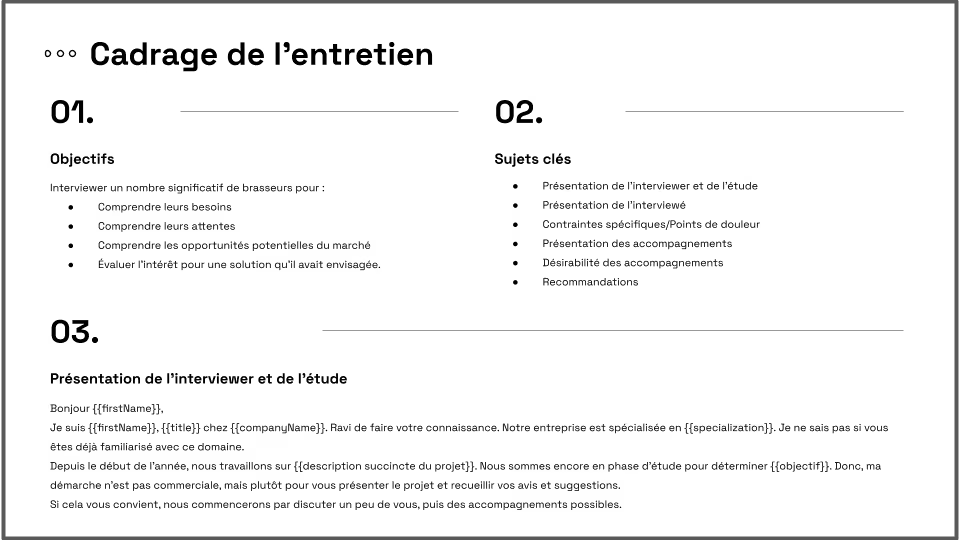
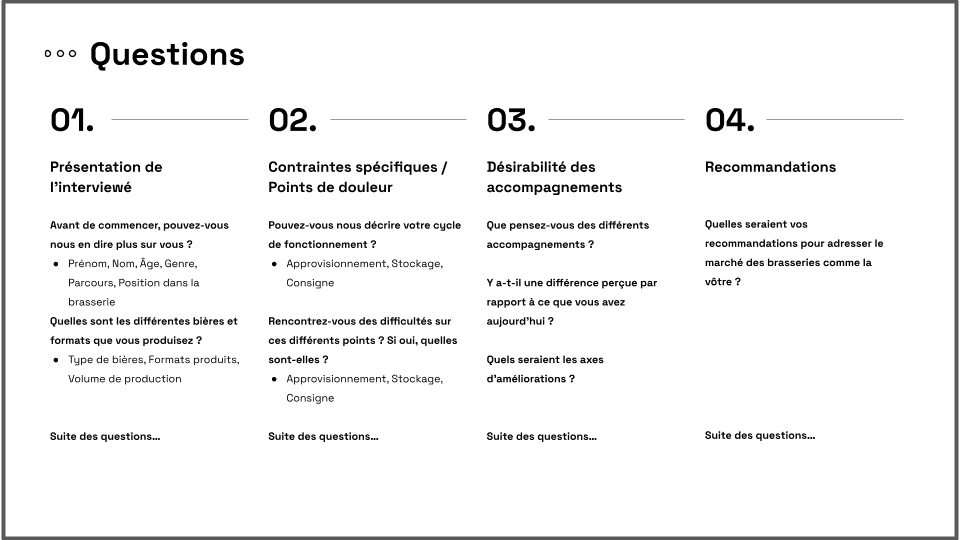
To help you explore this topic further and make the process easier for you, we’re providing an exampleof a qualitative study we typically conduct, along with the guide template we used.
Last year, one of our clients wanted to conduct qualitative market research on French microbreweries. After an initial phase of conceptualization and then marketing for their innovation project, their goal was to interview a significant number of these brewers in order to:
- understand their needs, expectations, and potential market opportunities,
- to gauge interest in the innovative project he had proposed.
At Dynergie, we refer to this type of qualitative market research as a “market validation test.” The goal is to test your hypotheses by gathering information to validate or invalidate the commercial potential of an offering in a specific market.
Dynergie, a consulting firm that supports you in your qualitative market research
At Dynergie, we specialize in conducting qualitative and quantitative studies for innovation projects. We refer to this type of qualitative study as“market validation tests,” and if you are an SME or mid-sized company, financial assistance is available for this type of service. If you would like to benefit from the support of our experts, please contact us through our contact page.
Related articles

Nicolas Hily

After spending two years as an innovation consultant specializing in the implementation of strategies for bringing innovative solutions to market, I am now dedicated to driving Dynergie’s growth as the marketing and growth manager. Throughout my career, I have had the opportunity to experiment with numerous methods and principles drawn from real-world experience, my clients, my colleagues, and various sources of information. Today, I’m delighted to have the opportunity to share this expertise with you. I hope to share my vision of innovation and marketing through these various posts.